





Standard Uranium Intersects Anomalous Radioactivity and Graphitic Reactivated Structure at Rocas Uranium Project; Initial Drill Program Complete
Press Release
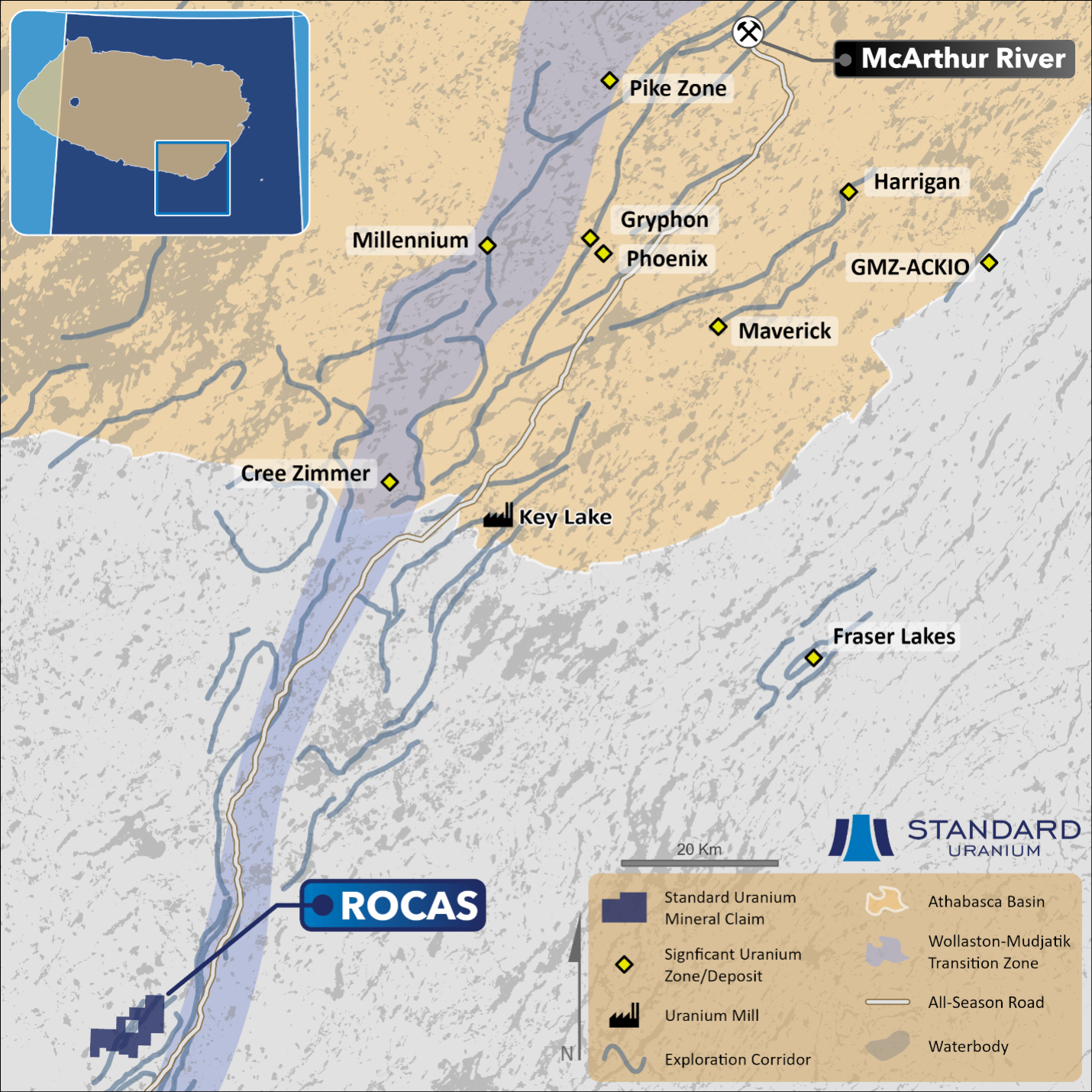
Vancouver, British Columbia, May 6, 2026 — Standard Uranium Ltd. (“Standard Uranium” or the “Company”) (TSX-V: STND) (OTCQB: STTDF) (Frankfurt: FWB:9SU0) is pleased to announce that drilling activities have been completed at the Company’s Rocas Uranium Project (“Rocas”, or the “Project”) located 75 kilometers southwest of the Key Lake Mine and Mill facilities along Highway 914. The inaugural drilling program targeted anomalies derived from the 2025 prospecting results and integrated geophysical data, including recent ground gravity and historical VTEM anomalies. The Project is currently under a three-year earn-in option agreement (the “Option Agreement”) with Collective Metals Inc. (“Collective”) (CSE: COMT).
Highlights
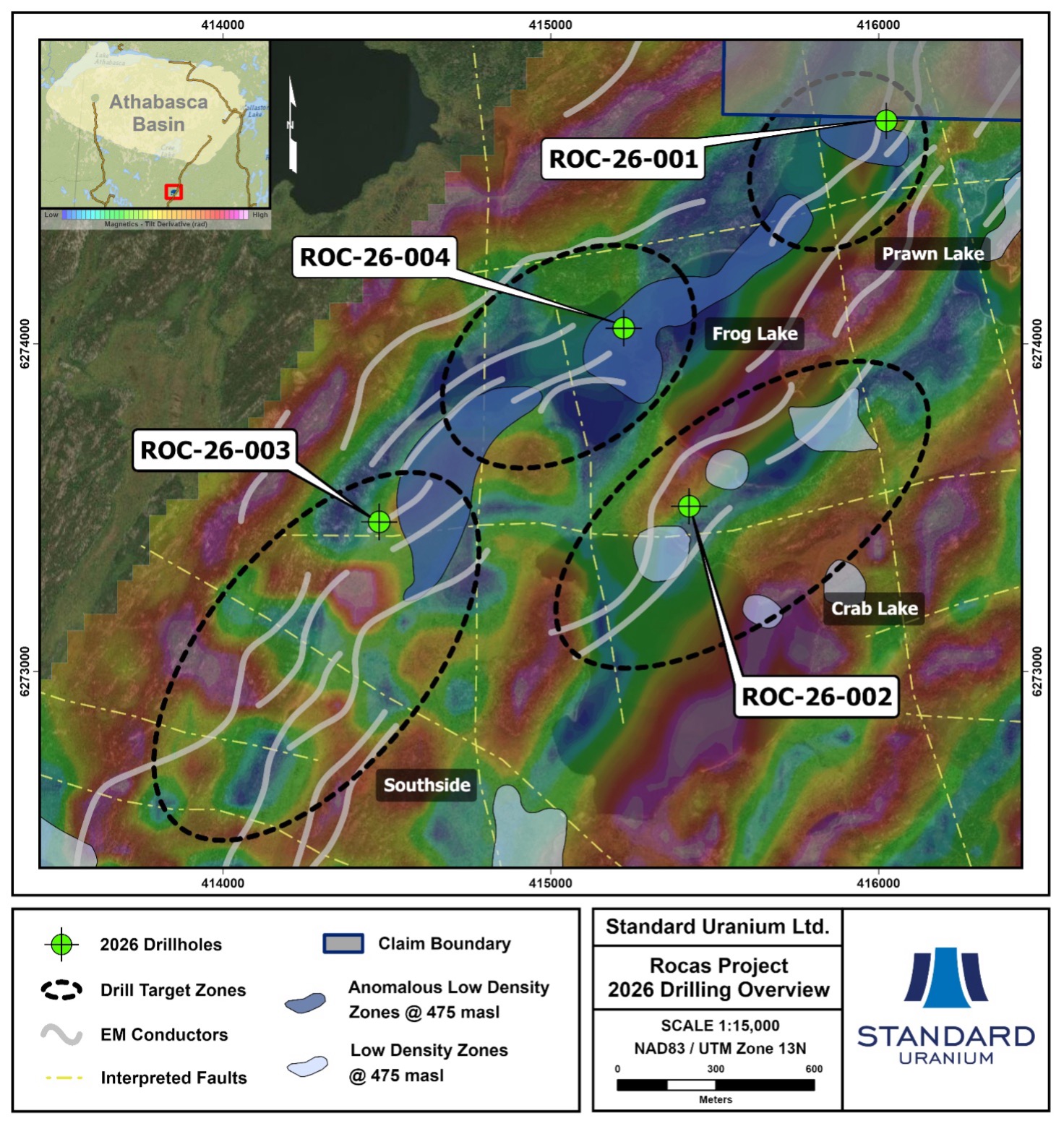
- Program Completion: A total of 962 metres were completed across four reconnaissance drill holes at the Upper Prawn Lake, Southside, and Crab Lake target areas (Figure 1).
- Anomalous Radioactivity: Multiple intervals of anomalous* radioactivity exceeding 300 counts per second (“cps”) were intersected in (3) three of the (4) four holes, totalling 1.5 metres of composite radioactivity. Geochemical assays are pending.
- Geophysical Correlation: The intersection of graphitic metasediments and associated sulphide mineralization in all four holes validates the Project’s electromagnetic (“EM”) signatures and confirms the accuracy of the current geophysical model. Significant graphitic sequences are confirmed in ROC-26-001 (0-76 m) and ROC-26-003 (36-84 m), with graphitic fault gouge also present in ROC-26-004.
- Structural Corridors: Brittle graphitic structures and clay gouge indicate structural reactivation and the conduits necessary for mineralizing fluids. Secondary hematite and clay alteration confirm hydrothermal processes – a key indicator for uranium deposition.
- Future Work: A phase two drilling program is currently being designed to follow up on this reconnaissance work. The integration of these latest results will refine and test additional regional targets across more than 5 km of untested conductor strike-length.
“Validating our geophysical model with graphitic structure and anomalous radioactivity in three of our first four basement intersections is a fantastic outcome for this first-pass drill program,” said Sean Hillacre, President & VP Exploration for the Company. “Confirming the presence of hydrothermal alteration and key structural conduits also strongly supports the potential for a significant discovery. We look forward to receiving the lab assays, refining our targets, and preparing for the next phase of drilling.”
Figure 1. Regional overview of the Rocas Project along Highway 914
Figure 2. Rocas Project overview, highlighting target areas tested during the 2026 drill program
2026 Drill Program – Preliminary Results
The winter drilling program totaled 962 meters across four reconnaissance drill holes. Three holes intersected anomalous* radioactivity and all four contain reactivated graphitic structures. This inaugural program tested three high-priority target areas identified by integrating 2025 ground gravity data, historical VTEM electromagnetics, and surface geological information and mineralization recorded during the 2025 prospecting program1. Radiometric results and drill hole data are provided in Table 1.
The four completed drill holes encountered highly favorable geological settings for basement-hosted uranium deposits, including:
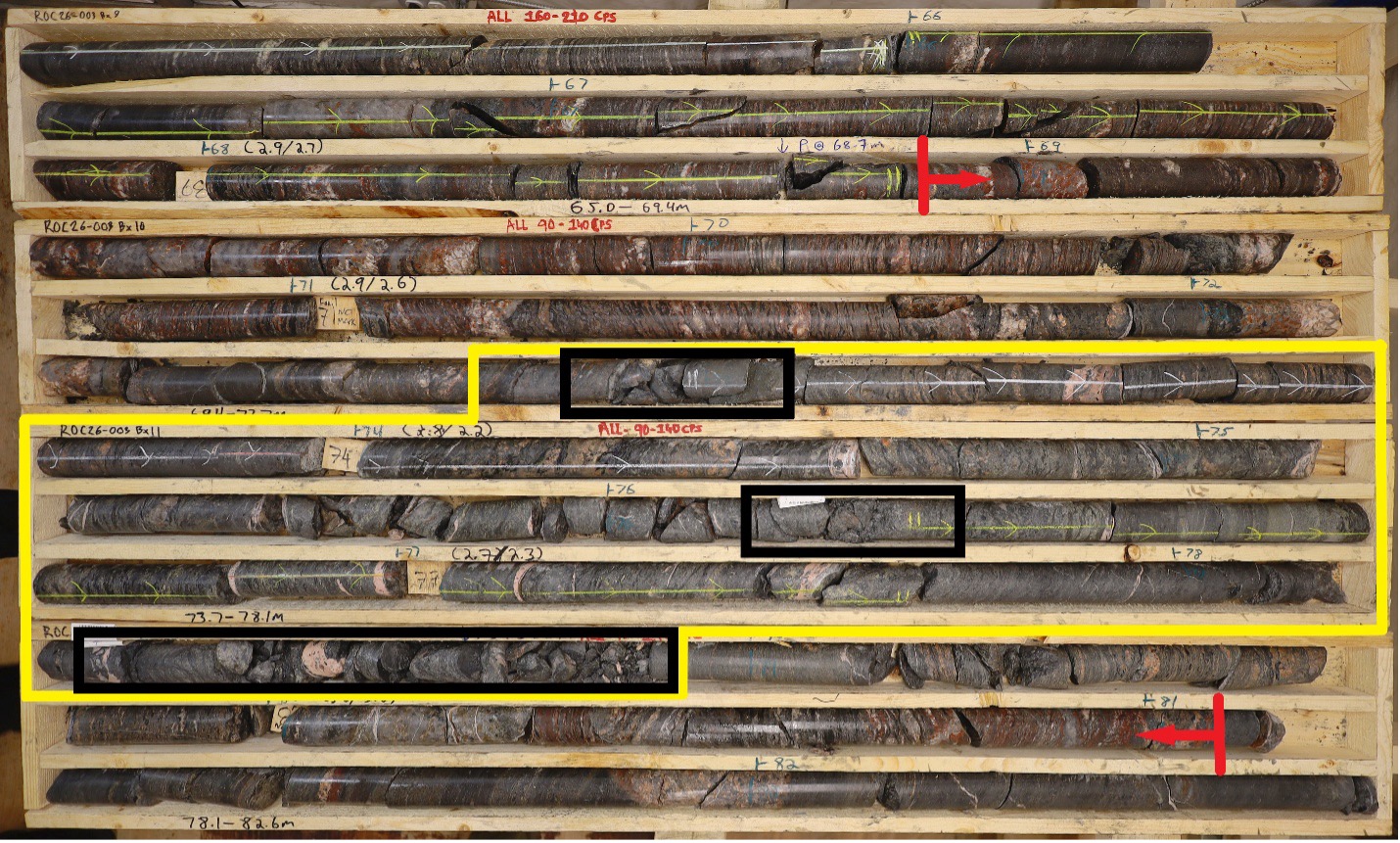
- Graphitic metasediments: Combined intersection downhole thickness of 114 m across all four drillholes, including local fault zones featuring brittle reactivation and graphitic fault gouge, breccias, and cataclasites. Most notable is a 9-metre graphitic fault zone in ROC-26-003 (73-82 m) characterized by dark charcoal-gray cataclastic matrix with 5-10 cm graphitic fault gouge intervals and minor pyrite and pyrrhotite – a highly prospective structural setting for uranium. Accompanying clay alteration and hydrothermal hematite observed locally.
- Hydrothermal Alteration: Key alteration includes clay replacement, chlorite, carbonate, and secondary hematite in and surrounding the above-mentioned graphitic fault zones, providing evidence of the hydrothermal processes required for uranium deposition.
- Anomalous Radioactivity: Multiple intervals of anomalous* radioactivity, with notable intersections including 0.5 m up to 360 cps in ROC-26-003 (40.5-41.0 m), 0.5 m up to 320 cps in ROC-26-004 (71.0-71.5 m), and 0.5 m at peak 650 cps in ROC-26-001 (208.5-209.0 m) totalling 1.5 metres of composite anomalous radioactivity.
Table 1. Winter 2026 Rocas drilling radioactivity results
Figure 3. Drill core photo of chloritized graphitic pelitic gneiss in ROC-26-001
Figure 4. Drill core photo from ROC-26-003: Clay-altered graphitic pelitic gneiss (yellow), with reactivated gouge/cataclasite intervals (black), carbonate veining, and bounding hydrothermal hematite alteration (red)
Next Steps & Follow Up
Building on the success of the 2026 program, the Company and its partner, Collective Metals Inc., are planning follow-up activities to expand upon recent results:
- Regional Prospecting: Continued mapping and sampling will be conducted on radioactive anomalies identified during the 2025 season to refine drill targets.
- Systematic Corridor Testing: Future drilling will move systematically along the remaining untested 5 km of the 7.5 km EM corridor, focusing on extrapolated conductors and areas with anomalous geochemistry and surface Uranium/Rare Earth Element mineralization.
- Geophysical Expansion: The Company intends to expand ground gravity and EM coverage to the north and south of the current target areas to identify additional structural offsets and traps for uranium mineralization.
Drill core samples have been collected systematically for whole-rock multi-element geochemical analysis and submitted to SRC Geoanalytical Laboratories in Saskatoon for U3O8 and Rare Earth Element (“REE”) assay. These results will be integrated with detailed logging and structural modelling to prioritize follow-up target areas.
The Rocas Project is positioned near the margin of the Athabasca Basin, where bedrock is covered by minimal glacial till. The 2017 airborne EM surveys defined conductive trends sub-parallel to the Key Lake Road Shear Zone, suggesting favorable metasedimentary basement lithologies. Standard Uranium believes the combination of cross-cutting structures and significant surficial mineralization makes the project highly prospective for shallow, high-grade** basement-hosted uranium.
Qualified Person Statement
The scientific and technical information contained in this news release has been reviewed and approved by Sean Hillacre, P.Geo., President and VP Exploration of the Company and a “qualified person” as defined in NI 43-101 – Standards of Disclosure for Mineral Projects.
Geochemical assays are pending. Samples collected for analysis were sent to SRC Geoanalytical Laboratories in Saskatoon, Saskatchewan for preparation, processing, and ICP-MS or ICP-OES multi-element analysis using total and partial digestion and boron by fusion. SRC is an ISO/IEC 17025:2005 and Standards Council of Canada certified analytical laboratory. Blanks, standard reference materials, and repeats were inserted into the sample stream at regular intervals in accordance with Standard Uranium’s quality assurance/quality control (“QA/QC”) protocols. All sample results will be subject to internal QA/QC protocols prior to subsequent release.
Historical data disclosed in this news release relating to sampling results from previous operators are historical in nature. Neither the Company nor a qualified person has yet verified this data and therefore investors should not place undue reliance on such data. The Company’s future exploration work may include verification of the data. The Company considers historical results to be relevant as an exploration guide and to assess the mineralization as well as economic potential of exploration projects. Any historical grab samples disclosed are selected samples and may not represent true underlying mineralization.
Natural gamma radiation from rocks reported in this news release was measured in counts per second (“cps”) using a handheld RS-125 super-spectrometer and RS-120 super-scintillometer. Readers are cautioned that scintillometer readings are not uniformly or directly related to uranium grades of the rock sample measured and should be treated only as a preliminary indication of the presence of radioactive minerals. Because the orientation of mineralization is unknown, true widths are unknown and reported intervals represent core lengths. The RS-125 and RS-120 units supplied by Radiation Solutions Inc. (“RSI”) have been calibrated on specially designed Test Pads by RSI. Standard Uranium maintains an internal QA/QC procedure for calibration and calculation of drift in radioactivity readings through three test pads containing known concentrations of radioactive minerals. Internal test pad radioactivity readings are known and regularly compared to readings measured by the handheld scintillometers for QA/QC purposes.
References
- Standard Uranium Confirms Anomalous Uranium and High-Grade Rare Earth Element Mineralization up to 9.83% TREO* at Surface on the Rocas Project, https://www.standarduranium.ca/news-releases/duplicate-standard-uranium-announces-plans-for-inaugural-drill-program-at-the-rocas-uranium-project
* Using a handheld RS-125 Super-Spectrometer, readings exceeding 300 counts per second (cps) are considered “anomalous,” while those exceeding 65,535 cps are considered “off-scale.”
** The Company defines uranium concentrations greater than 1.0 wt.% as “high-grade.”
*** Natural gamma radiation in outcrop reported in this news release was measured in counts per second (cps) using a handheld RS-125 super-spectrometer. Readers are cautioned that handheld scintillometer/spectrometer and gamma probe readings are not uniformly or directly related to uranium grades of the rock sample measured and should be treated only as a preliminary indication of the presence of radioactive minerals.
About Standard Uranium (TSX-V: STND)
We find the fuel to power a clean energy future
Standard Uranium is a uranium exploration company and emerging project generator poised for discovery in one of the world’s premier uranium districts. The Company holds interest in over 232,864 acres (94,237 hectares) in the Athabasca Basin in Saskatchewan, Canada. Since its establishment, Standard Uranium has focused on the identification, acquisition, and exploration of Athabasca-style uranium targets with a view to discovery and future development.
Standard Uranium’s Davidson River Project, in the southwest part of the Athabasca Basin, Saskatchewan, comprises ten mineral claims over 30,737 hectares. Davidson River is highly prospective for basement-hosted uranium deposits due to its location along trend from recent high-grade uranium discoveries. However, owing to the large project size with multiple targets, it remains broadly under-tested by drilling. Recent intersections of wide, structurally deformed and strongly altered shear zones provide significant confidence in the exploration model and future success is expected.
Standard Uranium’s eastern Athabasca projects comprise over 42,145 hectares of prospective land holdings. The eastern basin projects are highly prospective for unconformity related and/or basement hosted uranium deposits based on historical uranium occurrences, recently identified geophysical anomalies, and location along trend from several high-grade uranium discoveries.
Standard Uranium’s Sun Dog project, in the northwest part of the Athabasca Basin, Saskatchewan, is comprised of nine mineral claims over 19,603 hectares. The Sun Dog project is highly prospective for basement and unconformity hosted uranium deposits yet remains largely untested by sufficient drilling despite its location proximal to uranium discoveries in the area.
For further information contact:
Jon Bey, Chief Executive Officer, and Chairman
Suite 3123, 595 Burrard Street
Vancouver, British Columbia, V7X 1J1
Tel: 1 (306) 850-6699
E-mail: info@standarduranium.ca
IBF4