




Standard Uranium Prepares to Mobilize for Inaugural Drill Program and Announces Completion of Ground Gravity Survey on the Corvo Uranium Project
Press Release
Vancouver, British Columbia, January 13, 2026 — Standard Uranium Ltd. (“Standard Uranium” or the “Company”) (TSX-V: STND) (OTCQB: STTDF) (Frankfurt: FWB:9SU0) is pleased to announce that drilling and mobilization plans have been finalized for the maiden drilling campaign on the Corvo Uranium Project (“Corvo”, or the “Project”). Additionally, the Company announces the completion of an extensive high-resolution ground gravity survey across the Project. The Project is currently under a three-year earn-in option agreement (the “Option Agreement”) with Aventis Energy Inc. (“Aventis”) (CSE: AVE). Pursuant to the Option Agreement, Aventis has been granted an option (the “Option”) to earn a 75% interest in the Project by funding CAD$6M in exploration expenditures over three years, with the inaugural drill program beginning in February 2026.
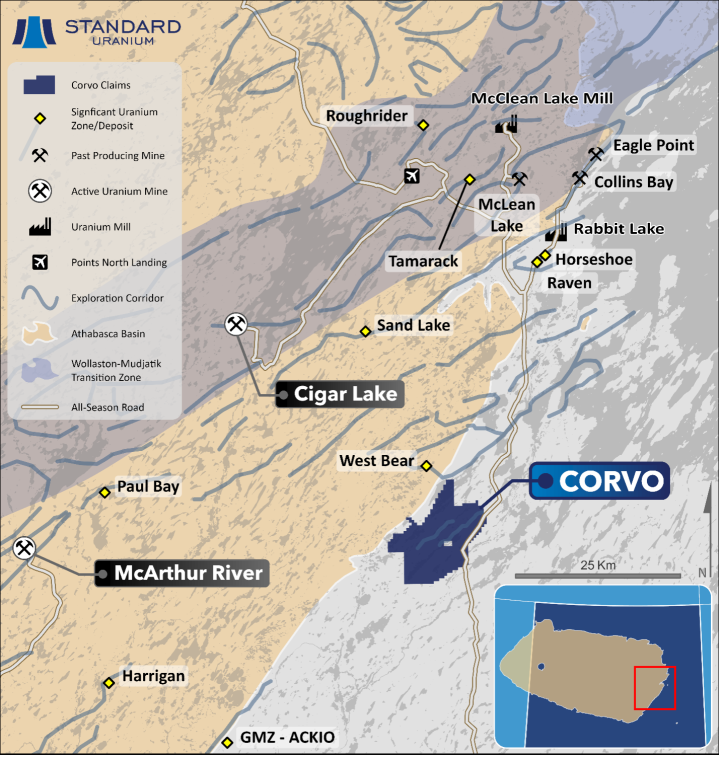
The Company and Aventis are pleased to announce that final planning is complete for the inaugural winter drill program on the Project, situated in the prolific eastern Athabasca Basin region (Figure 1). Exploration teams will be mobilizing to the field in early February, ahead of schedule.
Highlights:
- Drill Plan Finalized: Approximately 2,500 – 3,000 metres planned across 8-10 drill holes, targeting shallow high-grade* basement-hosted uranium mineralization.
- Robust & Shallow Drill Targets: Drill plans comprise skid-supported diamond drilling focused on high-priority uranium targets refined by geophysical work completed by the Company in 2025. Uranium target zones on the Project lie within less than 200 – 300 metres below surface.
- Untapped Uranium Potential: One diamond drill will focus on the highest-priority target area along the northern electromagnetic corridor (Figure 2), investigating the never-before-drilled Manhattan Showing (8.10% U3O8 at surface1), coincident with modeled electromagnetic conductors for the first time.
- Fully Funded: Aventis will be funding 100% of the program to meet the year-one expenditure requirements under the Option Agreement.
- Key Vendors Secured: The Company has engaged all key contracts for the program and diamond drilling crews will mobilize to the Corvo Project in January to begin constructing Project access.
“Our technical team and partners at Aventis are thrilled to begin drilling the exciting targets identified along more than 29 km of structural corridors on the Project for the first time, exploring for shallow high-grade uranium mineralization,” said Sean Hillacre, President & VP Exploration for the Company. “Our exploration thesis on the Project is directly analogous to the targeting strategies that lead to nearby discoveries in the Wollaston Domain such as the Rabbit Lake deposit and the GMZ and Ackio zones.”
Figure 1. Regional map of the Corvo Project. The Project is located 60 km due east of Cameco’s McArthur River mine and 45 km northeast of Atha Energy’s Gemini Mineralized Zone (“GMZ”).
2026 Exploration Programs
In late 2025, the Company contracted MWH Geo-Surveys (Canada) Ltd. (“MWH”) to complete an extensive 50 m x 200 m ground gravity survey covering more than 29 km of conductive strike length, designed to aid in identifying density anomalies that may represent hydrothermal alteration systems coinciding with uranium fertile electromagnetic (“EM”) conductor trends. MWH completed the geophysical grid in early January 2026, and the survey comprised more than 5,000 individual gravity measurement stations.
A skid-assisted diamond drill program totalling approximately 3,000 metres is planned for winter 2026, which will mark the first drill program on the Project in more than 40 years. Drilling will target high-priority areas including the never-before-drilled Manhattan Showing and other newly-identified radioactive occurrences across the property. Outcrop grab samples collected earlier this year returned uranium assays reaching a maximum of 8.10% U3O8 at the Manhattan Showing1 (Figure 2).
The Company believes the Project is highly prospective for the discovery of shallow, high-grade* basement-hosted uranium mineralization akin to the Rabbit Lake deposit and the recently discovered GMZ and Ackio zone. Located just outside the current margin of the Athabasca Basin, Corvo boasts shallow drill targets with bedrock under minimal cover of glacial till.
Figure 2. Summary map showing EM conductor trends on the Corvo project and highlighting the Manhattan Showing, with Reduced-To-Pole Total Magnetic Intensity in the background.
Qualified Person Statement
The scientific and technical information contained in this news release has been reviewed, verified, and approved by Sean Hillacre, P.Geo., President and VP Exploration of the Company and a “qualified person” as defined in NI 43-101 – Standards of Disclosure for Mineral Projects.
Samples collected for analysis were sent to SRC Geoanalytical Laboratories in Saskatoon, Saskatchewan for preparation, processing, and ICP-MS or ICP-OES multi-element analysis using total and partial digestion and boron by fusion. Radioactive samples were tested using the ICP1 uranium multi-element exploration package plus boron. All samples marked as radioactive upon arrival to the lab were also analyzed using the U3O8 assay (reported in wt.%). SRC is an ISO/IEC 17025:2005 and Standards Council of Canada certified analytical laboratory. Blanks, standard reference materials, and repeats were inserted into the sample stream at regular intervals in accordance with Standard Uranium’s quality assurance/quality control (QA/QC) protocols. All samples passed internal QA/QC protocols and the results presented in this release are deemed complete, reliable, and repeatable.
Historical data disclosed in this news release relating to sampling results from previous operators are historical in nature. Neither the Company nor a qualified person has yet verified this data and therefore investors should not place undue reliance on such data. The Company’s future exploration work may include verification of the data. The Company considers historical results to be relevant as an exploration guide and to assess the mineralization as well as economic potential of exploration projects. Any historical grab samples disclosed are selected samples and may not represent true underlying mineralization.
Natural gamma radiation from rocks reported in this news release was measured in counts per second (“cps”) using a handheld RS-125 super-spectrometer and RS-120 super-scintillometer. Readers are cautioned that scintillometer readings are not uniformly or directly related to uranium grades of the rock sample measured and should be treated only as a preliminary indication of the presence of radioactive minerals. The RS-125 and RS-120 units supplied by Radiation Solutions Inc. (“RSI”) have been calibrated on specially designed Test Pads by RSI. Standard Uranium maintains an internal QA/QC procedure for calibration and calculation of drift in radioactivity readings through three test pads containing known concentrations of radioactive minerals. Internal test pad radioactivity readings are known and regularly compared to readings measured by the handheld scintillometers for QA/QC purposes.
References
1 News Release: Standard Uranium Confirms High-Grade Uranium Mineralization up to 8.10% U3O8 at Surface on the Corvo Project, https://standarduranium.ca/news-releases/standard-uranium-confirms-high-grade-uranium-mineralization-at-surface-on-the-corvo-project/
*The Company considers uranium mineralization with concentrations greater than 1.0 wt% U3O8 to be “high-grade”.
**The Company considers radioactivity readings greater than 65,535 counts per second (cps) on a handheld RS-125 Super-Spectrometer to be “off-scale”.
***The Company considers radioactivity readings greater than 300 counts per second (cps) on a handheld RS-125 Super-Spectrometer to be “anomalous”.
About Standard Uranium (TSX-V: STND)
We find the fuel to power a clean energy future
Standard Uranium is a uranium exploration company and emerging project generator poised for discovery in the world’s richest uranium district. The Company holds interest in over 235,678 acres (95,375 hectares) in the world-class Athabasca Basin in Saskatchewan, Canada. Since its establishment, Standard Uranium has focused on the identification, acquisition, and exploration of Athabasca-style uranium targets with a view to discovery and future development.
Standard Uranium’s Davidson River Project, in the southwest part of the Athabasca Basin, Saskatchewan, comprises ten mineral claims over 30,737 hectares. Davidson River is highly prospective for basement-hosted uranium deposits due to its location along trend from recent high-grade uranium discoveries. However, owing to the large project size with multiple targets, it remains broadly under-tested by drilling. Recent intersections of wide, structurally deformed and strongly altered shear zones provide significant confidence in the exploration model and future success is expected.
Standard Uranium’s eastern Athabasca projects comprise over 45,000 hectares of prospective land holdings. The eastern basin projects are highly prospective for unconformity related and/or basement hosted uranium deposits based on historical uranium occurrences, recently identified geophysical anomalies, and location along trend from several high-grade uranium discoveries.
Standard Uranium’s Sun Dog project, in the northwest part of the Athabasca Basin, Saskatchewan, is comprised of nine mineral claims over 19,603 hectares. The Sun Dog project is highly prospective for basement and unconformity hosted uranium deposits yet remains largely untested by sufficient drilling despite its location proximal to uranium discoveries in the area.
For further information contact:
Jon Bey, Chief Executive Officer, and Chairman
Suite 3123, 595 Burrard Street
Vancouver, British Columbia, V7X 1J1
Tel: 1 (306) 850-6699
E-mail: info@standarduranium.ca
IBF4