




Canamera Energy Metals Files Independent Technical Report on Schryburt Lake Recommending a C$1.5 Million Phase 1 Program Targeting REE-Niobium Mineralization at Five Priority Targets
Press Release
Edmonton, Alberta–(- April 28, 2026) – Canamera Energy Metals Corp. (CSE: EMET) (OTCQB: EMETF) (FSE: 4LF0) (“Canamera” or the “Company”) is pleased to announce the filing of an independent National Instrument 43-101 – Standards of Disclosure for Mineral Projects (“NI 43-101”) technical report (the “Technical Report”) on the Schryburt Lake rare earth element (“REE”) and niobium project (the “Project” or “Schryburt Lake”) located in the Patricia Mining Division of northwestern Ontario, which Technical Report recommends a robust Phase 1 exploration program at the Project, including the recommendation for a 1,500-metre, nine-hole diamond drilling program across multiple priority target areas at the Schryburt Lake Carbonatite Complex (the “SLCC”). The Technical Report – effective April 15, 2026, authored by J Garry Clark, P.Geo., of Clark Exploration Consulting Inc., an independent Qualified Person (the “Independent QP”) as defined under NI 43-101, and available under the Company’s profile on SEDAR+ at www.sedarplus.ca – provides the first comprehensive technical assessment of the Project under Canamera’s option.
“The Technical Report gives Canamera a rigorous, independently reviewed foundation for advancing Schryburt Lake – the first under our option – and recommends a clearly defined Phase 1 drill program,” said Brad Brodeur, Chief Executive Officer of Canamera Energy Metals Corp. “Schryburt Lake is a rare and genuinely underexplored carbonatite system in one of Canada’s most active mining districts, and we believe it offers our shareholders the potential of differentiated exposure to permanent-magnet rare earths and niobium at a time of intense strategic focus on Western critical mineral supply chains.”
Project Overview
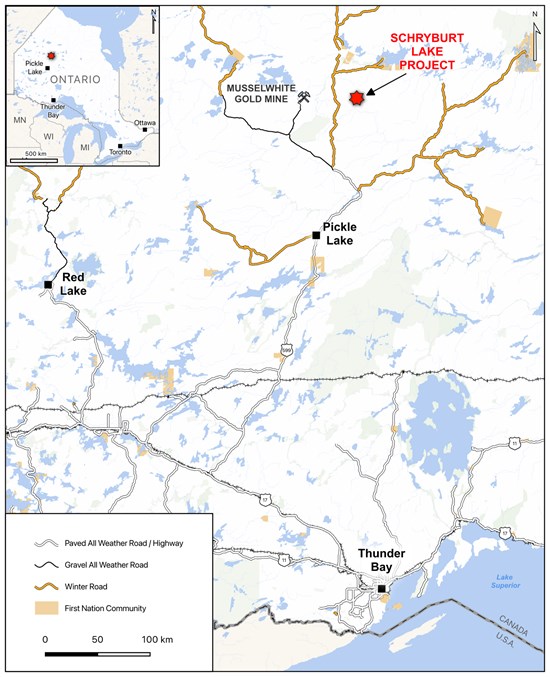
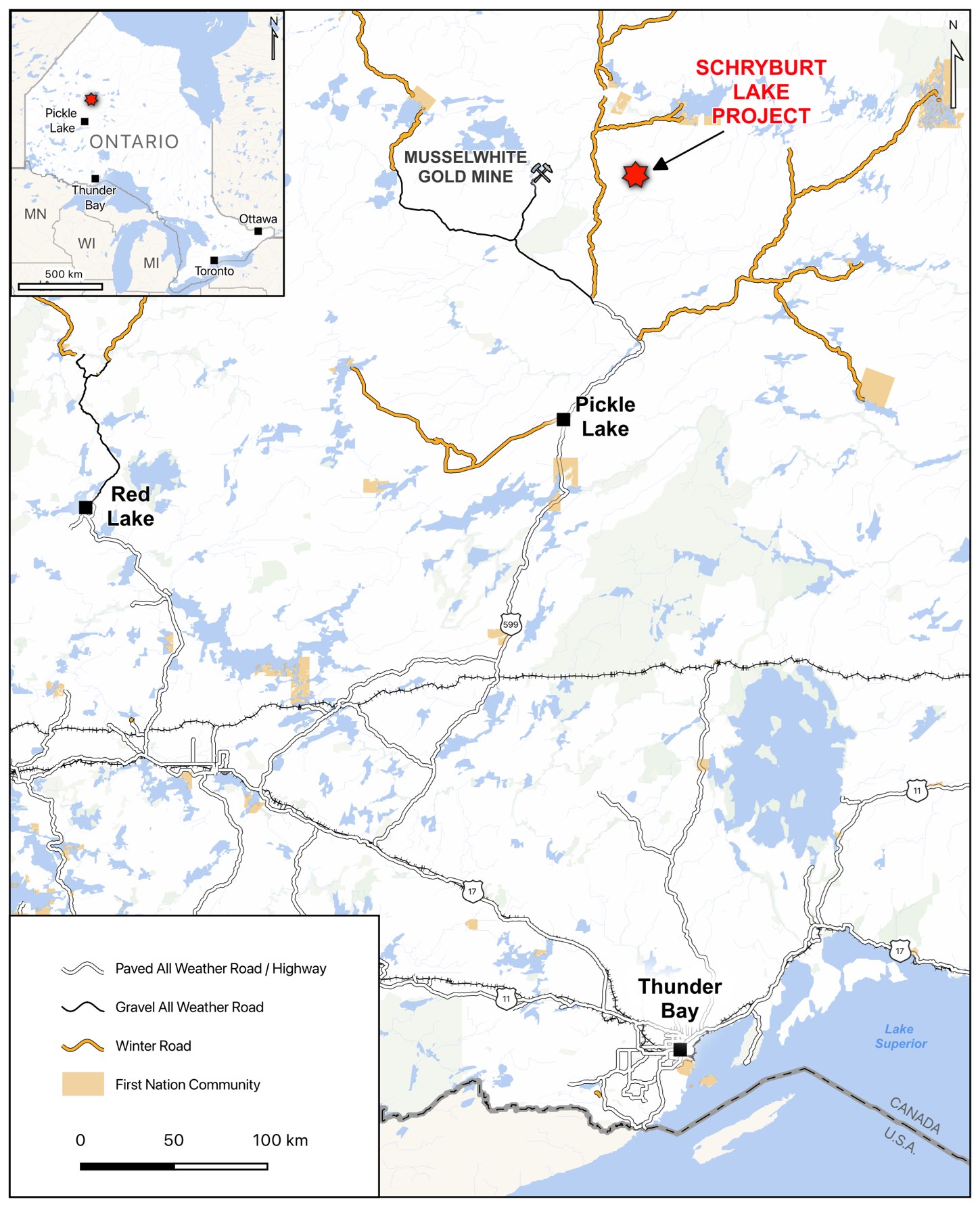
The Project is located approximately 135 kilometres north-northeast of Pickle Lake, Ontario, and approximately 50 kilometres east of Orla Mining Ltd.’s producing Musselwhite Mine, within the Patricia Mining Division, with road access to within 30 kilometres of the Project. The Project comprises 252 unpatented single-cell mining claims covering 4,947 hectares, registered 100% in the name of Dixon Metals (Ontario) Corporation, a wholly owned subsidiary of Bindi Metals Limited (ASX: BIM) (“Bindi”), and is subject to a 1.0% net smelter return royalty payable to the original vendor. Canamera has the right to earn up to a 90% interest in the Project pursuant to a joint venture option agreement (the “Joint Venture Option Agreement”) with Bindi (see Company’s news release dated November 14, 2025 and the Technical Report).
Figure 1: Location of the Schryburt Lake Project, Patricia Mining Division, northwestern Ontario.
To view an enhanced version of this graphic, please visit:
https://images.newsfilecorp.com/files/11828/294540_7cc7a706a4686969_001full.jpg
Geological Setting
The SLCC is a Mesoproterozoic carbonatite intrusion dated at approximately 1,145 Ma (Sage, 1988) emplaced into Neoarchean gneisses of the Schade Lake Gneissic Complex, Island Lake Domain, North Caribou Superterrane. It is composed predominantly of calcite carbonatite (sövite) and silicocarbonatite, with minor dolomite carbonatite, magnetitite, and apatite-rich carbonatite, with a mapped geological diameter of approximately 3.3 kilometres and an aeromagnetic expression extending to approximately 5 kilometres.
Principal REE mineralogy comprises ancylite-(Ce) and carbocernaite, confirmed by powder X-ray diffraction and SEM-EDS analysis. Neodymium and praseodymium (“NdPr”) ratios reported in the Technical Report range from 17% to 26% across 2023 rock samples, with historical 1977 RC drill intervals reporting ratios up to 34% at drill hole SC-1 (see “Technical Disclosures” below). NdPr are the primary rare earth elements used in permanent magnets for electric vehicles, wind turbines, and other clean-energy applications.
Priority Target Areas
The Technical Report defines four flagship priority target areas at Schryburt Lake – Blue Jay, Goldfinch, Starling, and Blackbird, as previously disclosed in the Company’s news release dated January 20, 2026. A fifth target, Hummingbird, has been identified in the Technical Report as an additional exploration target and may be evaluated during Phase 1 subject to the findings of the independent geophysical review. The targets are supported by 2023 surface rock-chip sampling, airborne radiometric and biogeochemical surveys, and 3D magnetic inversion modelling, with highlights summarized below:
| Target | Key result | Geophysical anomaly depth |
| Blue Jay | 2023 rock chip (Sample K042532): 3.59% TREO with 0.47% Nb₂O₅; individual samples grading up to 0.66% Nb₂O₅ (Dixon Metals, 2023) | >1,000 m |
| Goldfinch | 2023 rock chip (Sample K042505): 0.31% TREO; 1961 historical trench sample (Sample 38D, Trench 28): 1.82% Nb₂O₅ (Many Lakes Exploration, 1961)* | >850 m |
| Blackbird | 2023 rock chip (Sample K042522): 0.35% TREO with 0.12% Nb₂O₅ (Dixon Metals, 2023) | >800 m |
| Starling | 1977 historical RC sonic drill hole SC-3 (IMC): 1.5 m at 5.65% REO with 2.00% ZrO₂ from 3.0 m depth* | >600 m |
| Hummingbird | 2023 rock chip (Sample K042540): 0.31% TREO (Dixon Metals, 2023) | Not modelled |
*Historical results; see “Technical Disclosures” below.
Geophysical Modelling
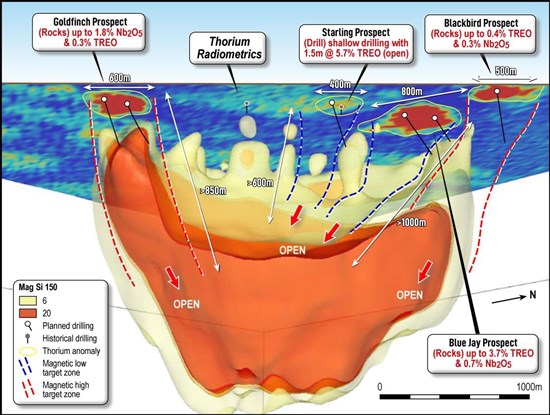
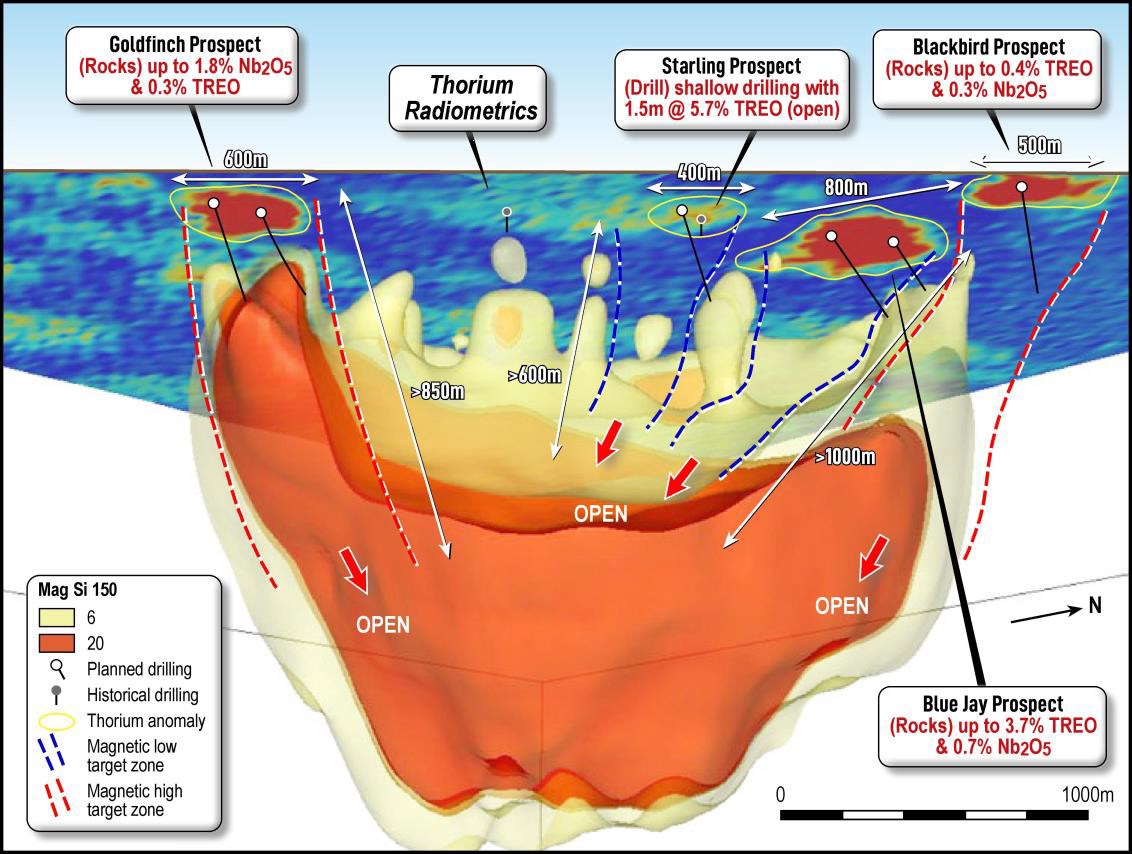
A 3D magnetic inversion model completed by Resource Potentials in 2023 has defined multiple pipe-like magnetic anomalies within and surrounding the SLCC, interpreted by the Independent QP as late-stage dykes or REE-Nb-enriched phases within the carbonatite complex, with modelled depth extents providing substantial vertical exploration potential across the target set. Supporting datasets include approximately 500 line-kilometres of helicopter-borne magnetic and radiometric coverage flown by Axiom Exploration in June 2023 at 50-metre line spacing, and a complementary biogeochemical survey comprising 130 black spruce bark samples completed by Dixon Metals over the same period.
Figure 2: Cross-section of the 3D magnetic inversion model at Schryburt Lake (Resource Potentials, 2023) looking northwest, showing pipe-like anomalies and modelled depth extents beneath the Blue Jay, Goldfinch, Blackbird, and Starling targets.
To view an enhanced version of this graphic, please visit:
https://images.newsfilecorp.com/files/11828/294540_7cc7a706a4686969_002full.jpg
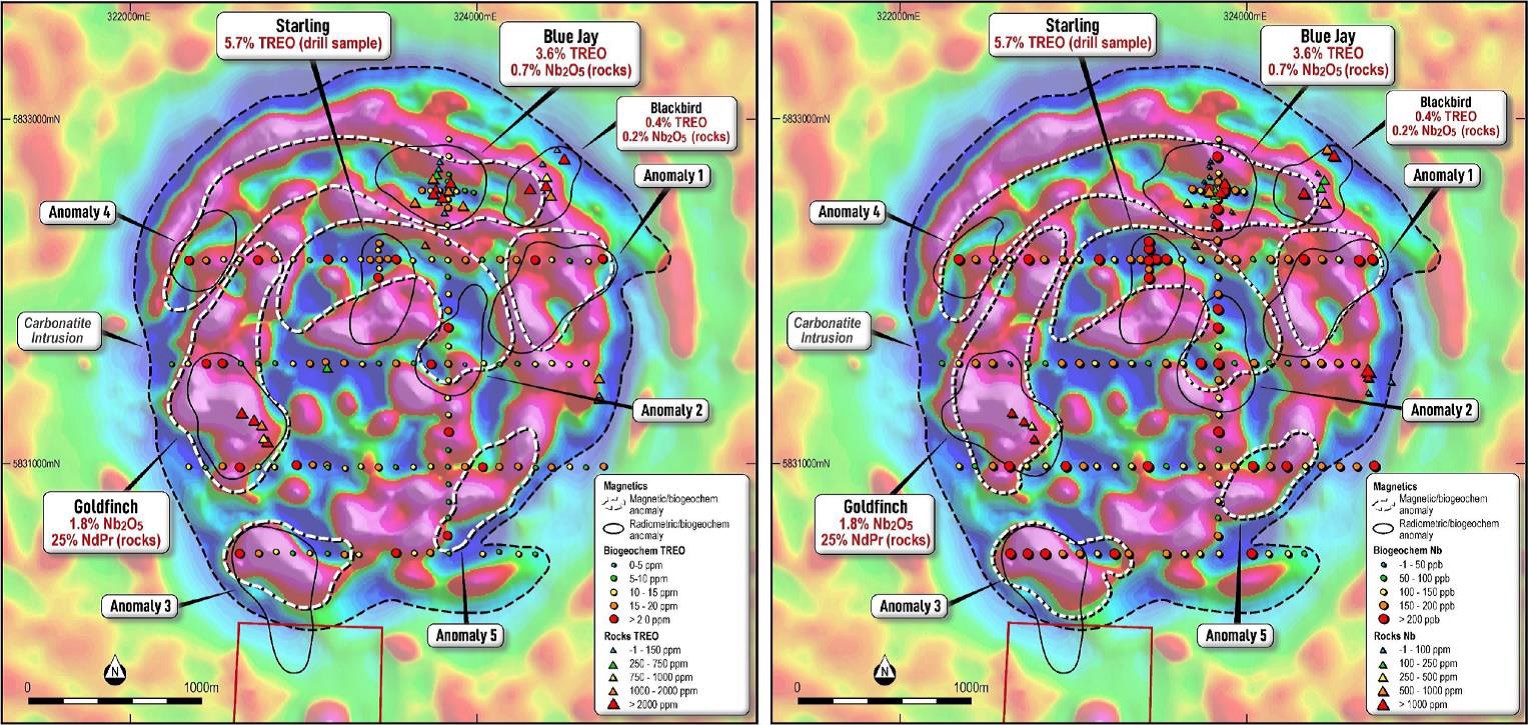
Figure 3: Thorium radiometric image with TREE biogeochemical results (left) and niobium biogeochemical results (right)
To view an enhanced version of this graphic, please visit:
https://images.newsfilecorp.com/files/11828/294540_7cc7a706a4686969_003full.jpg
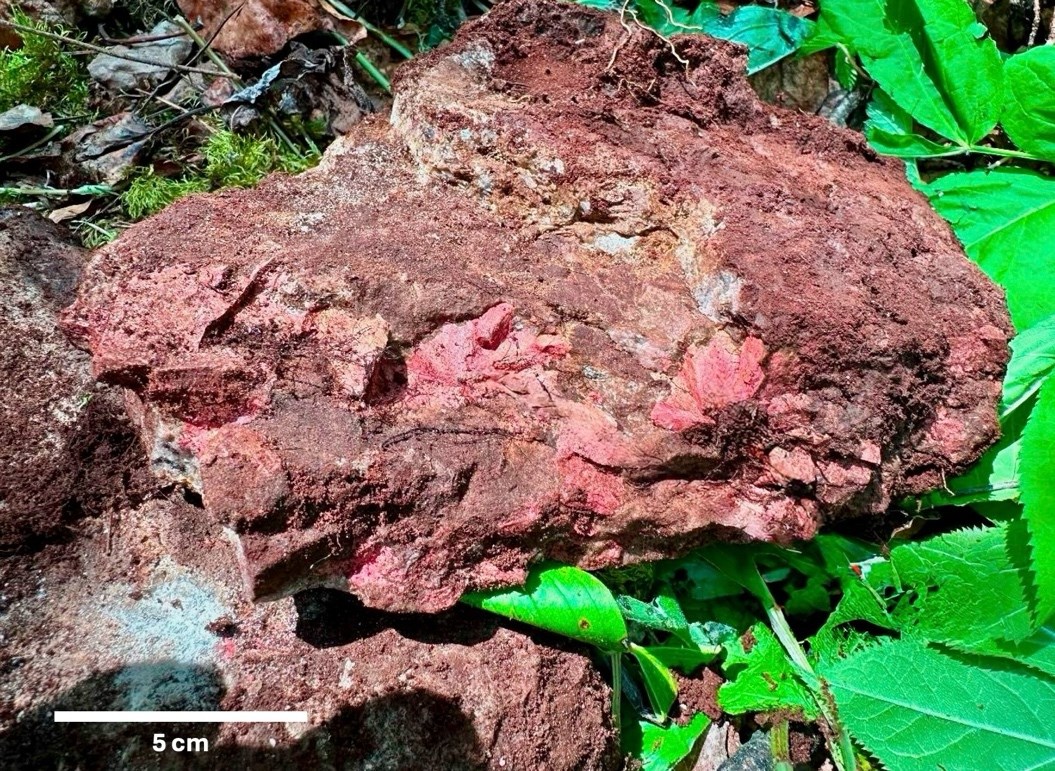
Figure 4: 2023 sample K042532 from the Blue Jay target area – intergrown ancylite-(Ce) and carbocernaite on a weathered outcrop surface; SEM-XRD confirmed; returned 3.588% TREO and 0.471% Nb₂O₅
To view an enhanced version of this graphic, please visit:
https://images.newsfilecorp.com/files/11828/294540_7cc7a706a4686969_004full.jpg
Recommended Phase 1 Program
The 1,500-metre diamond drill program recommended by the Technical Report is budgeted at C$1,403,575 (inclusive of a 15% contingency) and comprises nine BQTW core holes, helicopter-supported, with one contingent hole to be drilled subject to real-time handheld portable X-ray fluorescence (pXRF) screening of core from initial drilling.
The Company has applied for the required Ontario Exploration Permit (MLAS File No. PR-23-000172), which is currently under circulation review. Commencement of drilling at the Project is contingent upon the grant of the Ontario Exploration Permit. The Company is advancing planning with respect to the recommended drill program; however, there can be no assurance regarding the timing of the grant of the Ontario Exploration Permit or if such permit will be granted at all.
First Nations Engagement
The Company is actively engaged with the Kingfisher Lake, Mishkeegogamang, Nibinamik (Summer Beaver), and Wunnumin Lake First Nations in respect of the Project. As previously disclosed (see Company news release dated January 20, 2026), Canamera has engaged Andrew Best as Manager of Indigenous Relations – a Métis professional with over 30 years of experience advancing economic reconciliation and capacity building across the energy, mining, forestry, and aerospace sectors, most recently leading Indigenous engagement initiatives for mining companies operating in Canada’s Ring of Fire. Canamera is committed to conducting its exploration activities in a manner that respects Indigenous rights, fosters open communication, and creates opportunities for meaningful participation by local communities.
Technical Disclosures
Rock-chip samples referenced in this news release are grab samples and by their nature are selective; they are not necessarily representative of the mineralization hosted on the Project.
The historical results referenced in this news release – the 1961 Many Lakes Exploration grab sample at Goldfinch (analyzed for Nb₂O₅ with Ontario Department of Mines check-assays) and all 1977 International Minerals & Chemical Corp. RC sonic drilling data from the Project, including the 5.65% REO drill intercept at drill hole SC-3 and the NdPr ratios referenced in the Geological Setting section (Erdosh, 1977; semi-quantitative spectrographic analysis) – cannot be fully verified by the Independent QP due to incomplete documentation and the absence of original signed assay certificates. The Independent QP has concluded that the historical data are adequate for property-scale geological interpretation but not for mineral resource estimation and should be treated as historical in nature and used only as an indication of exploration potential. Investors are cautioned that these historical results should be considered order-of-magnitude estimates pending verification by modern analytical methods, are not indicative of the mineralization that may be encountered by Canamera on the Project and should not be relied upon.
The 2023 rock-chip sampling program was conducted by Dixon Metals, with analysis by AGAT Laboratories (Timmins, Ontario) using borate fusion full-suite REE and multi-element analysis, and QA/QC relying on internal laboratory standards and blanks. The Independent QP has accepted the 2023 data as reasonable for exploration purposes but has noted that the QA/QC protocols are not sufficient to support a mineral resource estimate. The Company has not yet conducted its own independent verification sampling on the Project.
Qualified Person
The scientific and technical information in this news release has been reviewed and approved by Warren Robb, P.Geo. (British Columbia), VP Exploration of Canamera Energy Metals Corp. and a “Qualified Person” as defined by NI 43-101. Mr. Robb is not independent of the Company within the meaning of NI 43-101. The Technical Report itself was authored by J Garry Clark, P.Geo., of Clark Exploration Consulting Inc., who is an independent Qualified Person as defined by NI 43-101.
About Canamera Energy Metals Corp.
Canamera Energy Metals Corp. is a rare earth elements exploration and development company with an expanding project portfolio across Brazil, the United States, and Canada. The Company is focused on advancing ionic clay REE projects in Brazil and critical mineral assets in North America to support Western rare earth supply chain independence. For more information, visit www.canamerametals.com.
For Further Information Please Contact:
Brad Brodeur
Chief Executive Officer
brad@canamerametals.com
780-238-7163
IBF4