




First Atlantic Nickel & Cobalt Highlights G7 Leaders’ Declaration on Critical Minerals: G7 Names Nickel One of Only Two Pilot Minerals for a New Allied Traceability Framework, Moves to Mobilize Equity Investment and Offtake, and Establishes a Critical Minerals Resilience and Production Alliance
Press Release
Grand Falls-Windsor, Newfoundland and Labrador–(- June 19, 2026) – First Atlantic Nickel & Cobalt Corp. (TSXV: FAN) (OTCQB: FANCF) (FSE: P21) (the “Company” or “First Atlantic”) today commented on the G7 Leaders’ Declaration on Securing Supply Chains for Critical Minerals, issued at the 2026 G7 Summit in Évian, France, on June 17, 2026.1
The declaration names lithium and nickel as the first two “pilot” critical minerals for a new G7-wide traceability framework; commits G7 governments to mobilize equity investment, guarantees and offtake to close the investment gap before 2030; and establishes a new G7 Critical Minerals Resilience and Production Alliance to coordinate financing, diversification and transparency across allied jurisdictions.
Nickel and cobalt are two of Canada’s six priority critical minerals, singled out from a list of 312. Both are also designated as critical minerals in the United States, where nickel holds a dual energy-and-defence designation. First Atlantic’s wholly owned Pipestone XL Nickel-Cobalt Alloy Project is located in Newfoundland, a G7 jurisdiction, and is being advanced as an allied source of awaruite, a naturally occurring nickel-iron-cobalt alloy (Ni-Fe-Co).
Awaruite (Ni3Fe) offers a pathway to fully vertical critical mineral supply chains inside the G7. Because this sulphur-free, naturally magnetic alloy already exists in metallic form, magnetic separation and flotation can upgrade it directly into a high-grade concentrate of approximately 60% nickel,[3] without the smelting, roasting or high-pressure acid leaching that conventional processing requires, and without the associated electricity demand, emissions and acid-mine-drainage risk. Awaruite concentrate can move directly into downstream battery refining, stainless steel, specialty alloys, aerospace and defence manufacturing. The Company believes this pathway is directly relevant to the processing capacity the G7 is mobilizing to build outside any single dominant supplier.
The U.S. Geological Survey identified this advantage in its 2012 Mineral Commodity Summaries: “Awaruite, a natural iron-nickel alloy, is much easier to concentrate than pentlandite, the principal sulfide of nickel.” Today, Chinese firms control roughly 75% of Indonesia’s nickel refining capacity[4], while Indonesia represents a growing share of the world’s processed nickel and cobalt supply. According to the U.S. Geological Survey’s 2026 Mineral Commodity Summaries for nickel, Indonesia alone accounted for approximately two-thirds of global nickel mine production in 2025, producing 2.6 million of the world’s 3.9 million tonnes.5 Awaruite’s simple magnetic-separation and flotation processing can produce a high-grade concentrate at the mine site for direct downstream use in stainless steel, EV battery refining, specialty alloys and other applications, offering a solution to constrained midstream smelting capacity in G7 countries.
On May 21, 2026, the Company announced electron microprobe analysis by SGS Canada Inc. confirming that awaruite at the Pipestone XL Project’s RPM Zone averages 77.62% nickel and 1.69% cobalt.
On June 15, 2026, the Company announced a second large-scale awaruite discovery at the Alloy Max Zone, where discovery hole XL-26-15 intersected visible awaruite over its entire 414-metre length and ended in open mineralization.
KEY POINTS
- Nickel Is One of Only Two Pilot Critical Minerals Selected by the G7: The declaration commits the G7 to harmonized, interoperable traceability mechanisms beginning with two pilot critical minerals, lithium and nickel, before extending to five new minerals each year. The Company believes this places nickel at the front of a multi-year allied effort to track, verify and prioritize trusted-source supply.
- The G7 Recognizes the Need to Mobilize Equity Investment, Guarantees and Offtake: The declaration recognizes that building processing and recycling capacity requires public and private capital, including equity investments, guarantees and offtake arrangements, and tasks G7 development finance institutions and export credit agencies with coordinating on critical minerals with the private sector. Canada and the United States are both G7 members and founding members of the Minerals Security Partnership.
- The G7 Targets Processing Capacity Outside a Single Dominant Supplier: The declaration commits members to building processing and industrial capacity to reduce dependence on a single supplier outside the G7. Awaruite’s magnetic-separation pathway is designed to bypass the midstream smelting step entirely, addressing a processing bottleneck that has contributed to G7 reliance on smelting capacity in non-G7 countries.
- A New G7 Critical Minerals Resilience and Production Alliance: The declaration establishes a non-binding alliance, open to like-minded partners, to coordinate diversification and resilience across the entire supply chain. Canada is a G7 member and helped launch its predecessor, the Critical Minerals Production Alliance, under the 2025 Canadian G7 presidency.
For investor inquiries or questions, please call Rob Guzman, Investor Relations, at +1-844-592-6337 or email rob@fanickel.com.
THE G7 SELECTED NICKEL AS ONE OF ONLY TWO PILOT CRITICAL MINERALS
Under the heading “Transparency and traceability,” the G7 leaders state:
“Acknowledging ongoing work by the Organisation for Economic Cooperation and Development (OECD) and International Energy Agency (IEA), we are committed to working towards establishing harmonized, interoperable mechanisms aligned with our interests that ensure traceability and transparency regarding the origin of critical minerals. This would start with two pilot critical minerals – lithium and nickel – and aim to avoid undermining competitiveness or imposing excessive cost burdens. We will seek to extend the pilot to five new critical minerals each year with particular attention given to rare earths.”
Nickel and lithium were selected as the two pilot critical minerals to launch the G7’s new traceability framework. The Company believes this selection underscores the strategic priority allied governments place on verifying the origin of nickel from trusted jurisdictions, including Canada.
THE G7 COMMITS TO EQUITY INVESTMENT, GUARANTEES AND OFFTAKE
Under the heading “Financing,” the G7 leaders state:
“We recognize that the development of industrial capacity, including processing and recycling, necessary for diversification, requires the mobilization of public and private capital, including equity investments, guarantees and offtakes. We recognize the increasing need for stable investment frameworks and for market transparency and valuation for the security of supply. This could incentivize financing of the critical minerals value chains to bridge the investment gap before 2030.”
The declaration tasks G7 development finance institutions and export credit agencies with coordinating on critical minerals with the private sector. Canada and the United States are both G7 members and were among founding members of the Minerals Security Partnership. The Company believes this reflects an emerging allied financing architecture for critical minerals projects in in trusted jurisdictions, including nickel and cobalt projects.
THE G7 STANDS AGAINST THE WEAPONIZATION OF MINERAL DEPENDENCE
In its opening, the G7 leaders state:
“We express our grave concerns regarding the use of non-market policies and practices and economic coercion, including arbitrary export restrictions and retaliatory measures on critical minerals and their related dual-use items, all of which undermine economic security and resilience. We will work together with partners to reduce critical dependencies and ensure that attempts or threats to weaponize economic dependencies fail.”
The reference to “dual-use items” is consistent with nickel’s strategic importance to both energy supply chains and the defence industrial base. Pipestone XL is positioned to supply nickel and cobalt to downstream industries spanning batteries, stainless steel, specialty alloys, aerospace and defence.
NEW G7 CRITICAL MINERALS RESILIENCE AND PRODUCTION ALLIANCE
Under the heading “Critical Minerals Resilience and Production Alliance,” the G7 leaders state:
“To achieve these objectives and ensure long-term coordination of our efforts, we establish a non-binding G7 Critical Minerals Resilience and Production Alliance, whose terms are annexed to this declaration. This initiative builds on the existing Critical Minerals Production Alliance and will be open to like-minded partners subject to the approval of participating countries.”
The predecessor body was established under the Canada’s G7 presidency in 2025. Australia, a G7 partner country, has also expressed support for the declaration. The Company believes the new Alliance may provide a durable, multi-year platform for longer-term coordination among allied countries on critical minerals supply chains, including nickel and cobalt projects in trusted jurisdictions.
NICKEL AND COBALT: CANADA’S PRIORITY MINERALS, NOW AT THE FRONT OF THE G7 AGENDA
Of the 34 minerals on Canada’s Critical Minerals List, the federal government has prioritized six: lithium, graphite, nickel, cobalt, copper and rare earth elements. Both nickel and cobalt are included in that priority group. In the G7 declaration, nickel is now one of only two minerals, alongside lithium, chosen to pilot the allied traceability framework.
The alignment is direct. Nickel is one of Canada’s six priority critical minerals and is now at the front of the G7’s traceability effort. First Atlantic’s strategy is built around these same priorities: trusted-source supply, midstream processing, and allied coordination on financing and offtake.
First Atlantic believes the policy direction reflected in the G7 declaration is consistent with the Company’s broader strategy to advance a North American nickel-cobalt project capable of supporting downstream industries in the United States and Canada, including battery refining, stainless steel, specialty alloys, defence manufacturing and advanced industrial applications.
AWARUITE: A SMELTER-FREE NICKEL-COBALT ALLOY (Ni₃Fe)
Awaruite is a naturally occurring, sulfur-free nickel-iron-cobalt alloy of approximately 77% nickel. Because it already exists in metallic form, it can be processed into a high-grade concentrate of approximately 60% nickel by magnetic separation and flotation (without smelting, roasting or high-pressure acid leaching) and sent directly to downstream battery-chemical refining or the manufacture of specialty alloys and stainless steel.
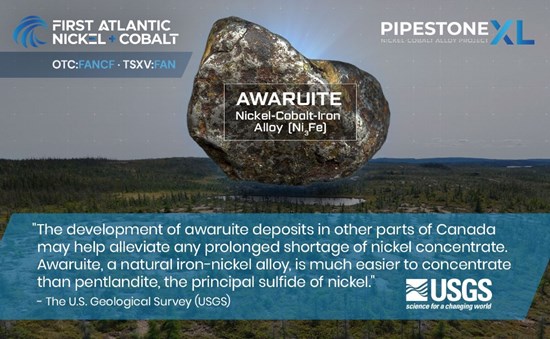
Figure 1: USGS quote on awaruite nickel-iron-cobalt alloy.
To view an enhanced version of this graphic, please visit:
https://images.newsfilecorp.com/files/6963/302166_d6260ccc24e7c867_001full.jpg
As stated in the August 2025 report From Rocks to Power: Strategies to Unlock Canada’s Critical Minerals for Global Leadership in Energy Storage, EVs, & Beyond from the Battery Metals Association of Canada:
“Awaruite is not a sulfide nor an oxide nickel ore but a high-content native nickel-iron ore. Simple beneficiation processes after mining could provide 60% Ni concentrate, ready for leaching for battery cathode purposes and would yield MHP as a by-product. This process would bypass pyrometallurgy or early hydrometallurgy stages and be among the lowest carbon-intensive nickel production sites in the global nickel market.”6
The U.S. Geological Survey highlighted awaruite’s potential in its Mineral Commodity Summaries 2012, stating:
“The development of awaruite deposits in other parts of Canada may help alleviate any prolonged shortage of nickel concentrate. Awaruite, a natural iron-nickel alloy, is much easier to concentrate than pentlandite, the principal sulfide of nickel.”7
The absence of sulfur reduces the risk of acid mine drainage and certain permitting challenges commonly associated with sulfide mineralization, positioning awaruite to supply North American industries including stainless steel, electric vehicles, aerospace, and defence.
INVESTOR INFORMATION
The Company’s common shares trade on the TSX Venture Exchange under the symbol “FAN”, the American OTCQB Exchange under the symbol “FANCF” and on several German exchanges, including Frankfurt and Tradegate, under the symbol “P21”.
Investors can get updates about First Atlantic by signing up to receive news via email and SMS text at www.fanickel.com.
For further information, please contact:
Rob Guzman
Investor Relations
1 (844) 592-6337
rob@fanickel.com
IBF5