





Greenridge Exploration Announces Results of Summer 2025 Drilling at the Carpenter Lake Uranium Project, Athabasca Basin Area
Press Release
January 22, 2026
Vancouver, B.C. – Greenridge Exploration Inc. (“Greenridge” or the “Company“) (CSE: GXP | OTC: GXPLF | FRA: HW3), is pleased to announce the results of the Summer 2025 diamond drilling program (the “Program”) at its Carpenter Lake Project (“Carpenter Lake” or the “Property”), located on the southern margin of the Athabasca Basin in northern Saskatchewan, Canada. Eight holes were completed for a total of 1,368 metres on selected target areas along the Cable Bay Shear Zone (the “CBSZ”), a major structural feature that bisects the Project,
Russell Starr, Chief Executive Officer of the Company, commented, “Our inaugural drilling program at Carpenter Lake successfully tested the targets available to us in the summer exploration season, and has presented invaluable geological information that will direct our future work on the Project. We have embarked upon what will become a systematic, multi-year exploration campaign, consistent with the generative nature of uranium exploration in the Athabasca Basin region.”
Highlights of the 2025 Drilling Program
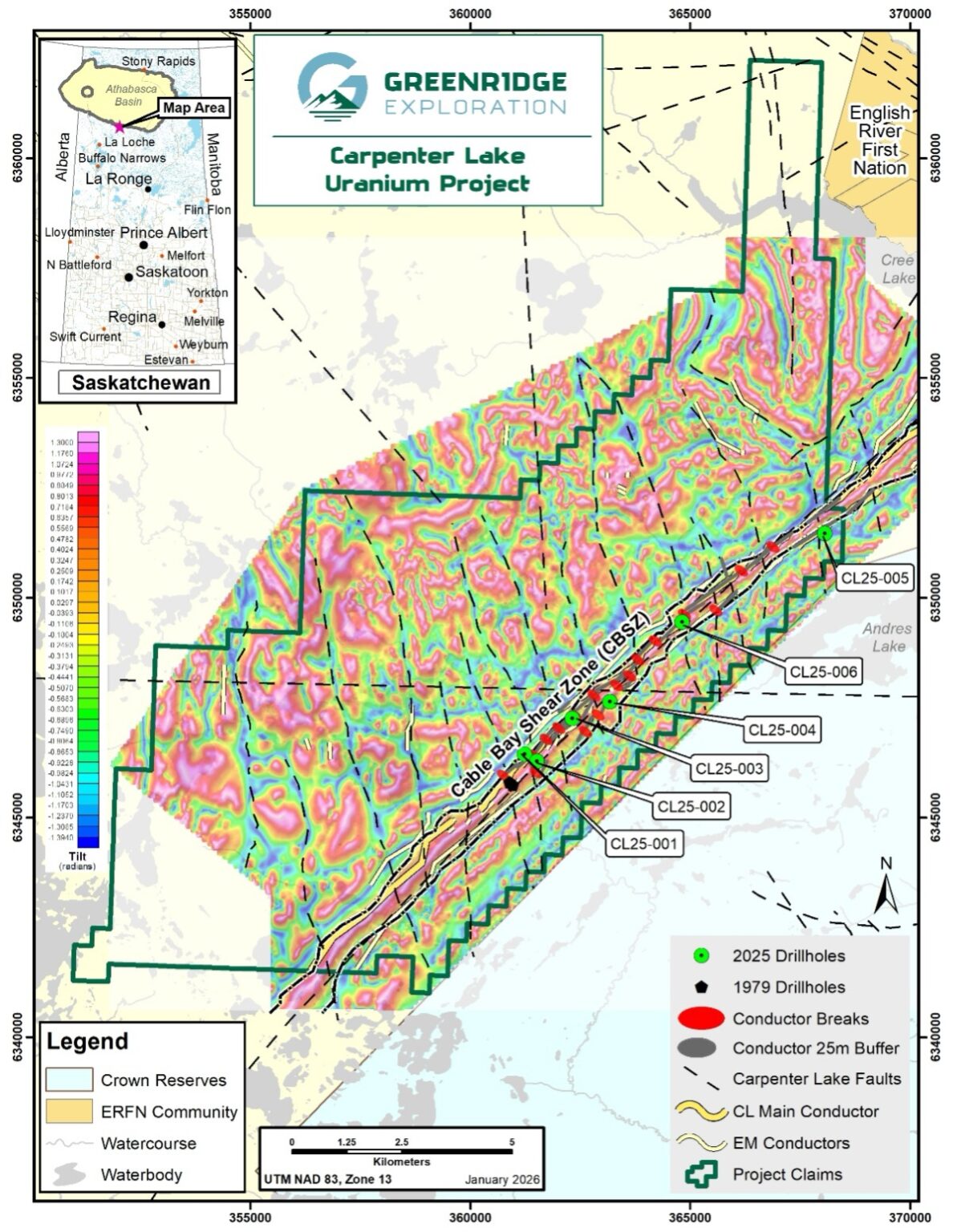
- Eight (8) holes were completed for a total of 1,368 m of core NQ drilling across select targets intended to test Geophysical and Geochemical targets along the CBSZ targeting shallow basement-hosted uranium mineralization at the target areas (Figure 1) (See Table 1). Two drillholes were lost before reaching their planned depth due to technical issues.
- Drilling intersected prospective lithologies for hosting uranium mineralization, namely graphitic pelitic gneisses carrying sulphides, with anomalous pathfinder geochemistry including uranium, arsenic, nickel, copper, cobalt, lead and zinc.
- Intervals of anomalous radioactivity (measured by downhole Mount Sopris 2PGA-1000 downhole gamma probe) were intersected in three of the eight drill holes completed and is associated with structural zones and favorable rock types including graphitic pelite adjacent to favorable cross structures, and structural breaks (Figure 2).
- Graphitic-sulphidic stacked shear and fault zones were encountered in multiple holes, many featuring prominent brittle reactivation features including breccias, cataclasites, and fault gouge (Figure 2).
- Anomalous dravite, a pathfinder clay alteration mineral containing boron, which is often found near a potential mineralized system, was observed by short wave infra-red (“SWIR”) spectroscopy and confirmed by laboratory analysis, showing strongly anomalous Boron associated with structural deformation and anomalous uranium.
- The 2025 drill program has demonstrated that the prospective graphitic pelitic gneisses at the Project extends further south than previously known, and that anomalous geochemistry observed in the drill core (uranium, boron and base metals) indicate that uranium-bearing fluids have mobilized along the CBSZ.
- The helicopter-assisted drilling operations generated a low environmental impact during drill moves and drill pad construction, providing a sustainable exploration practice.
Figure 1 – Carpenter Lake 2025 Drill Hole Locations structural elements.
About Carpenter Lake and the Cable Bay Shear Zone
Carpenter Lake is comprised of nine (9) mineral claims covering approximately 15,091 hectares owned 60% by Greenridge and 40% by Renegade Gold Inc., with Greenridge acting as operator of exploration activities. Greenridge can earn a 100% interest in the Property by fulfilling a schedule of cash payments, common share issuances and exploration expenditures (for details please see Greenridge news release dated May 30, 2024).
Carpenter Lake straddles the southern margin of the Athabasca Basin Supergroup sandstones and covers more than fifteen (15) kilometers of the CBSZ – a prominent crustal-scale geological structure trending northeast-southwest that is largely underexplored for uranium deposits (please see Figure 1). The CBSZ is characterized by a well-defined conductive signature, radiometric anomalies, and numerous historically-mapped uranium occurrences.
IBF4