





PMET Announces Multiple New Lithium/Caesium Discoveries in 2025 Drilling at the Shaakichiuwaanaan Property
Press Release
December 14, 2025
Highlights
- New lithium zone discovery in drill hole at the CV4 Pegmatite.
- 27.0 m at 1.14% Li2O including 19.2 m at 1.45% Li2O (CV25-1013).
- 13.0 m at 1.37% Li2O (CV25-1013).
- 11.5 m at 1.27% Li2O (CV25-950).
- Discovery interpreted to be a potential 1.5 km extension of the CV5 Pegmatite to the east.
- High-grade lithium discovery in drill hole at the CV12 Pegmatite.
- 29.0 m at 1.31% Li2O, including 12.5 m at 2.76% Li2O (CV25-875).
- 29.4 m at 1.28% Li2O, including 11.9 m at 2.86% Li2O (CV25-894).
- 41.3 m at 0.88% Li2O, including 27.5 m at 1.20% Li2O (CV25-922).
- New caesium zone discoverynear-surfacein drill hole at the CV12 Pegmatite.
- 3.0 m at 5.82% Cs2O within a wider anomalous zone of 23.0 m at 0.98% Cs2O (CV25-875).
- Zone traced over ~200 m strike length at ~1 to 4 m thickness.
- Strike lengths of the CV5 and CV13 pegmatitesextended to 5.0 km and 3.2 km, respectively, with drill results including:
- 24.9 m at 1.34% Li2O, including 11.2 m at 2.16% Li2O (CV25-879) – CV5
- 11.7 m at 1.16% Li2O, including 5.4 m at 1.98% Li2O (CV25-796) – CV13
- High-grade caesium intersected at CV5 – 0.5 m at 17.92% Cs2O (CV25-885).
- Assays remain pending for multiple infill and step-out holes at the CV13 and CV4 pegmatites, including the high-grade (Li, Cs, Ta) Vega Zone.
- The 2025 drill campaign also included 6,490 m (42 holes) of condemnation drilling north of CV5 and 3,961 m (21 holes) of geomechanical drilling at CV13 in support of development.
- A total 57,024 m (245 holes) of diamond drilling was completed over the 2025 calendar year with results for 41,943m (173 holes) reported herein – Results remain to be reported for 15,081 m (72 holes).
Darren L. Smith, Executive Vice President Exploration, comments: “The 2025 drill campaign at Shaakichiuwaanaan was expansive in scope and completed amongst a backdrop of two (2) Mineral Resource Estimate updates and a maiden Feasibility Study for lithium on the CV5 Pegmatite. The campaign included drill testing of new targets, infill and step-out holes proximal to defined Li-Cs-Ta Mineral Resources, as well as condemnation and geomechanical holes in support of development. I am happy to report that, through the teams’ efforts, the Company achieved its key drilling objectives on schedule and under budget with the Project now further derisked towards development as well as multiple new high-potential lithium and caesium zones discovered.”
“The emergence of caesium-rich mineralization across multiple areas of the Property underscores the robustness and highly evolved nature of the LCT Pegmatite system at Shaakichiuwaanaan. The presence of such high-value mineralization strengthens our confidence in the broader system and its ability to continue generating discoveries at scale that have the potential to enhance long-term shareholder value.” added Mr. Smith.
PMET Resources Inc. (the “Company” or “PMET”) (TSX: PMET) (ASX: PMT) (OTCQX: PMETF) (FSE: R9GA) is pleased to announce results from its extensive 2025 drill campaign at the Company’s wholly-owned Shaakichiuwaanaan Property (the “Property” or “Project”), located in the Eeyou Istchee James Bay region of Quebec.
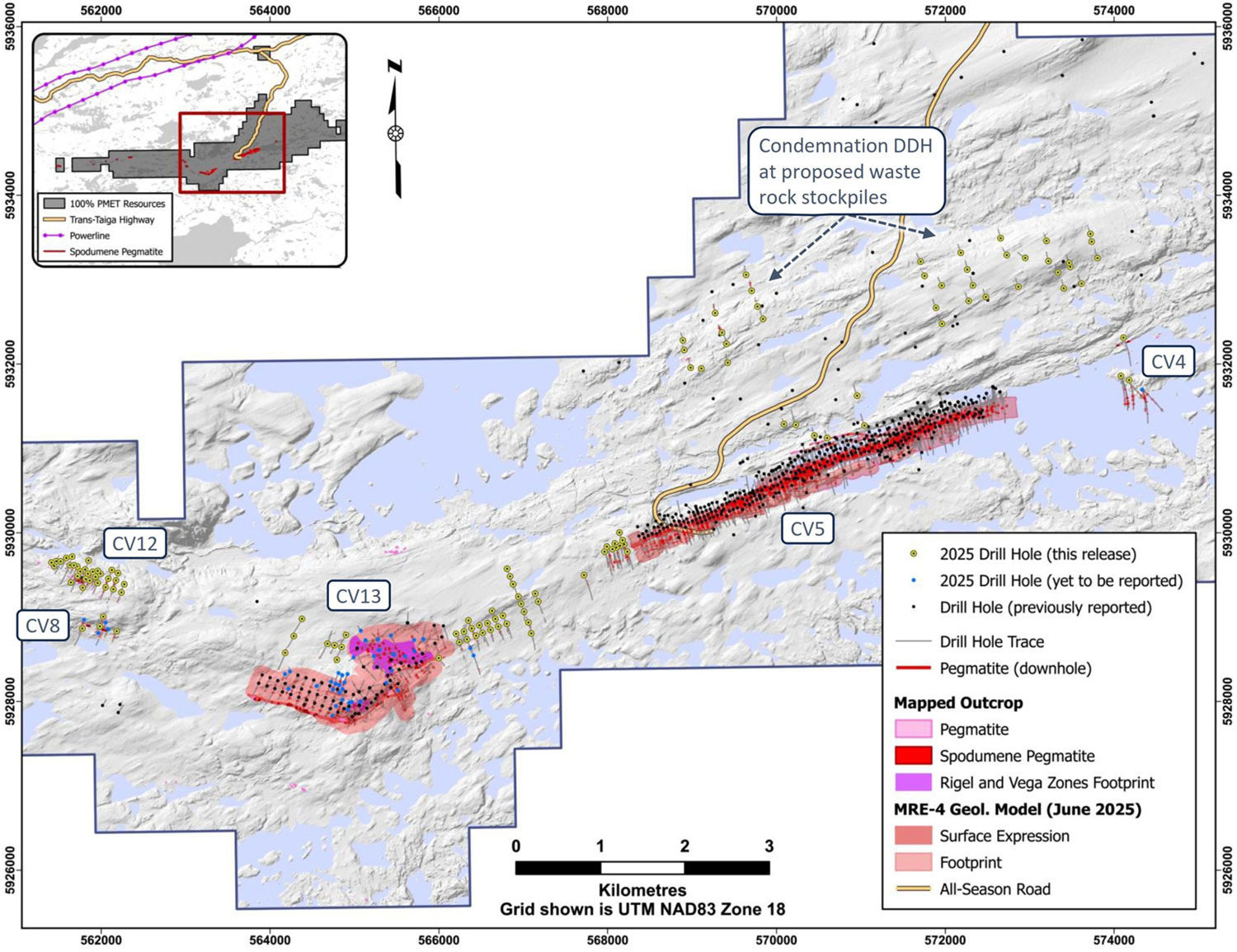
The Property hosts one of the largest pegmatite Mineral Resources[1] (Li, Cs, Ta) and Mineral Reserves[2] (Li) in the world, situated approximately 13 km south of the regional and all‑weather Trans-Taiga Road and powerline infrastructure corridor, and is accessible year-round by road. The Company recently announced a robust Feasibility Study for the CV5 Pegmatite, which outlined the Project as a potential North American critical mineral powerhouse (see news release dated October 20, 2025). The 2025 drill campaign at the Property was expansive in nature and included drill testing of multiple Li-Cs-Ta (“LCT”) pegmatite prospects (CV4, CV8, CV12), step-out drilling at CV5 and CV13, infill drilling at CV13, as well as condemnation and geomechanical drilling in support of development at CV5 and CV13, respectively. Over the course of the campaign, which was concluded in October, a total of 57,024 m (245 holes) of diamond drilling was completed, of which, results for 41,943 m (173 holes) are reported herein (see Figure 1, and Table 1 through Table 7).
[1] The Consolidated MRE (CV5 + CV13 pegmatites), which includes the Rigel and Vega caesium zones, totals 108.0 Mt at 1.40% Li2O, 0.11% Cs2O, 166 ppm Ta2O5, and 66 ppm Ga, Indicated, and 33.4 Mt at 1.33% Li2O, 0.21% Cs2O, 155 ppm Ta2O5, and 65 ppm Ga, Inferred, and is reported at a cut-off grade of 0.40% Li2O (open-pit), 0.60% Li2O (underground CV5), and 0.70% Li2O (underground CV13). A grade constraint of 0.50% Cs2O was used to model the Rigel and Vega caesium zones. The Effective Date is June 20, 2025 (through drill hole CV24-787). Mineral Resources are not Mineral Reserves as they do not have demonstrated economic viability. Mineral Resources are inclusive of Mineral Reserves.
[2] Probable Mineral Reserve of 84.3 Mt at 1.26% Li2O at the CV5 Pegmatite with a cut-off grade is 0.40% Li2O (open-pit) and 0.70% Li2O (underground). Underground development and open-pit marginal tonnage containing material above 0.37% Li2O are also included in the statement. The Effective Date is September 11, 2025. See Feasibility Study news release dated October 20, 2025.
Figure 1: Drill holes completed through 2025 at the Shaakichiuwaanaan Property.
CV4 Pegmatite
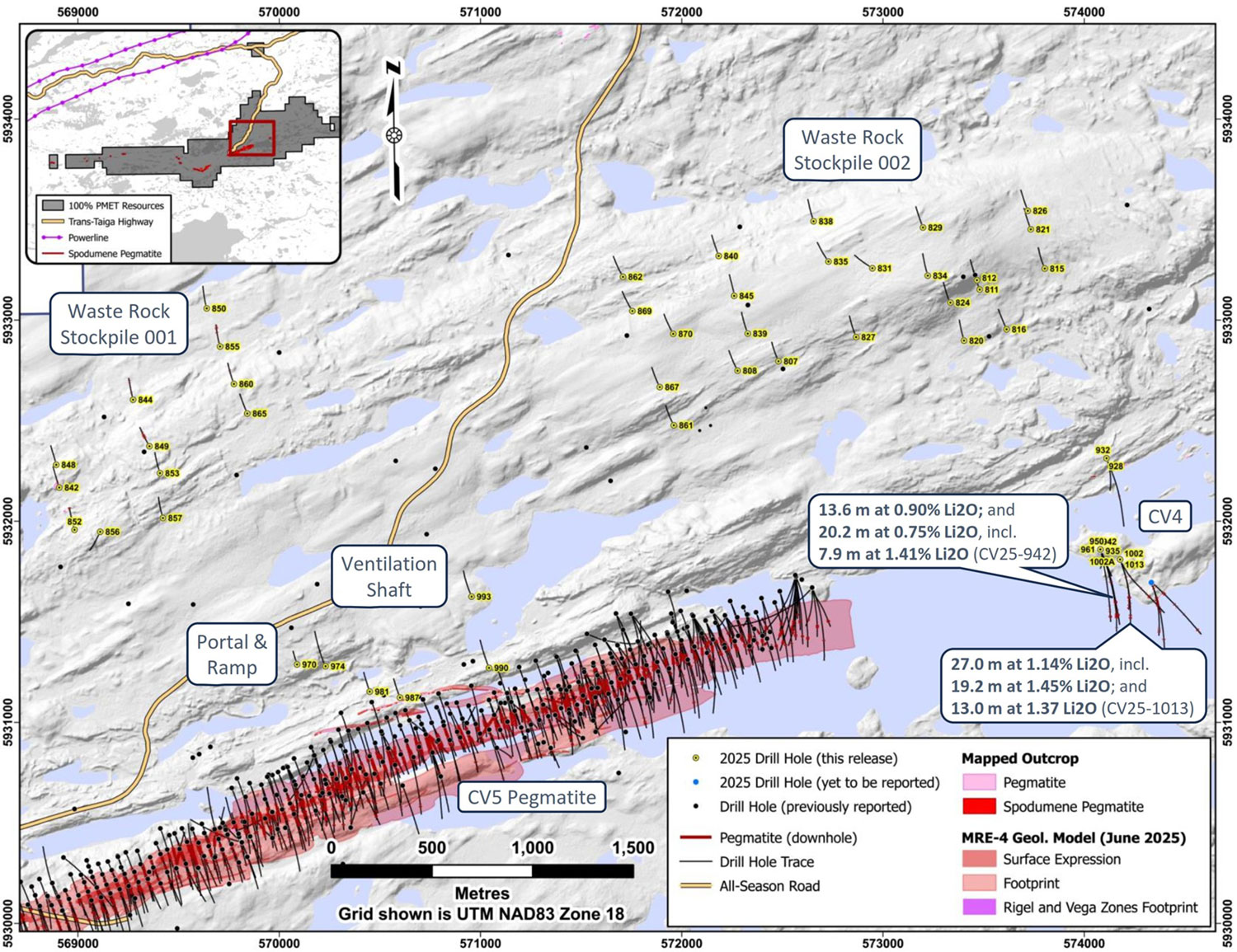
The CV4 Pegmatite, characterized at surface by multiple LCT pegmatite outcrops, is situated approximately 1.5 km along geological trend to the east of the CV5 Pegmatite. The 2025 campaign marked the maiden drill testing of the prospect with a total of 7,513 m (17 holes) completed, of which, results for 3,259 m (9 holes) are announced herein (see Figure 2, Table 1, and Table 7).
A drill fence was completed across the interpreted strike of the pegmatite outcrops and then continued south in an effort to intersect a potential extension of the principal pegmatite at CV5. The initial results indicate the outcrops have only limited depth extent; however, the drill fence successfully intersected significant widths of well-mineralized spodumene pegmatite at depth. Drill results include:
- 27.0 m at 1.14% Li2O including 19.2 m at 1.45% Li2O; and 13.0 m at 1.37% Li2O (CV25-1013).
- 11.5 m at 1.27% Li2O (CV25-950).
- 13.6 m at 0.90% Li2O; and 20.2 m at 0.75% Li2O including 7.9 m at 1.41% Li2O (CV25-942).
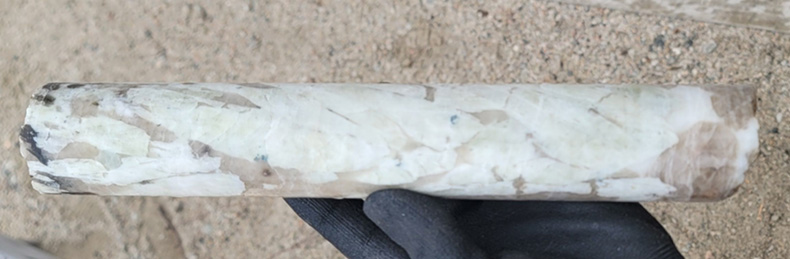
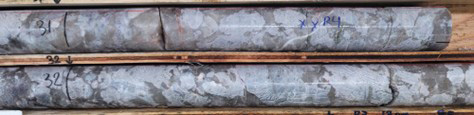
A preliminary review of the core indicates that the mineralization style in CV4 drill holes is similar to that of the principal pegmatite at CV5, characterized by large spodumene crystals hosted within a quartz-feldspar pegmatite (Figure 3). The spodumene mineralization consists of off-white to pale-green crystals of centimetre to decimetre scale, which are relatively free of inclusions resembling one of the common spodumene mineralization styles at CV5. This suggests potential amenability to dense media separation (“DMS”) process methods, which extensive testwork at CV5 has demonstrated to be very effective.
The discovery is significant and, coupled with down-ice boulder discoveries in the area (see news release dated March 25, 2025) and observations in core, is interpreted to represent a potential 1.5 km extension of the CV5 Pegmatite to the east. As such, the discovery expands potential for additional underground resources along strike of the current underground Mineral Reserves at the CV5 Pegmatite.
Figure 2: Drill holes completed through 2025 at the CV4 Pegmatite and north of the CV5 Pegmatite (condemnation holes).
Figure 3: Large spodumene crystals in drill hole CV25-942 at ~351 m depth (core length) at the CV4 Pegmatite. Core graded 1.4 m at 2.22% Li2O over sample interval (350.2 m to 351.6 m).
CV12 Pegmatite
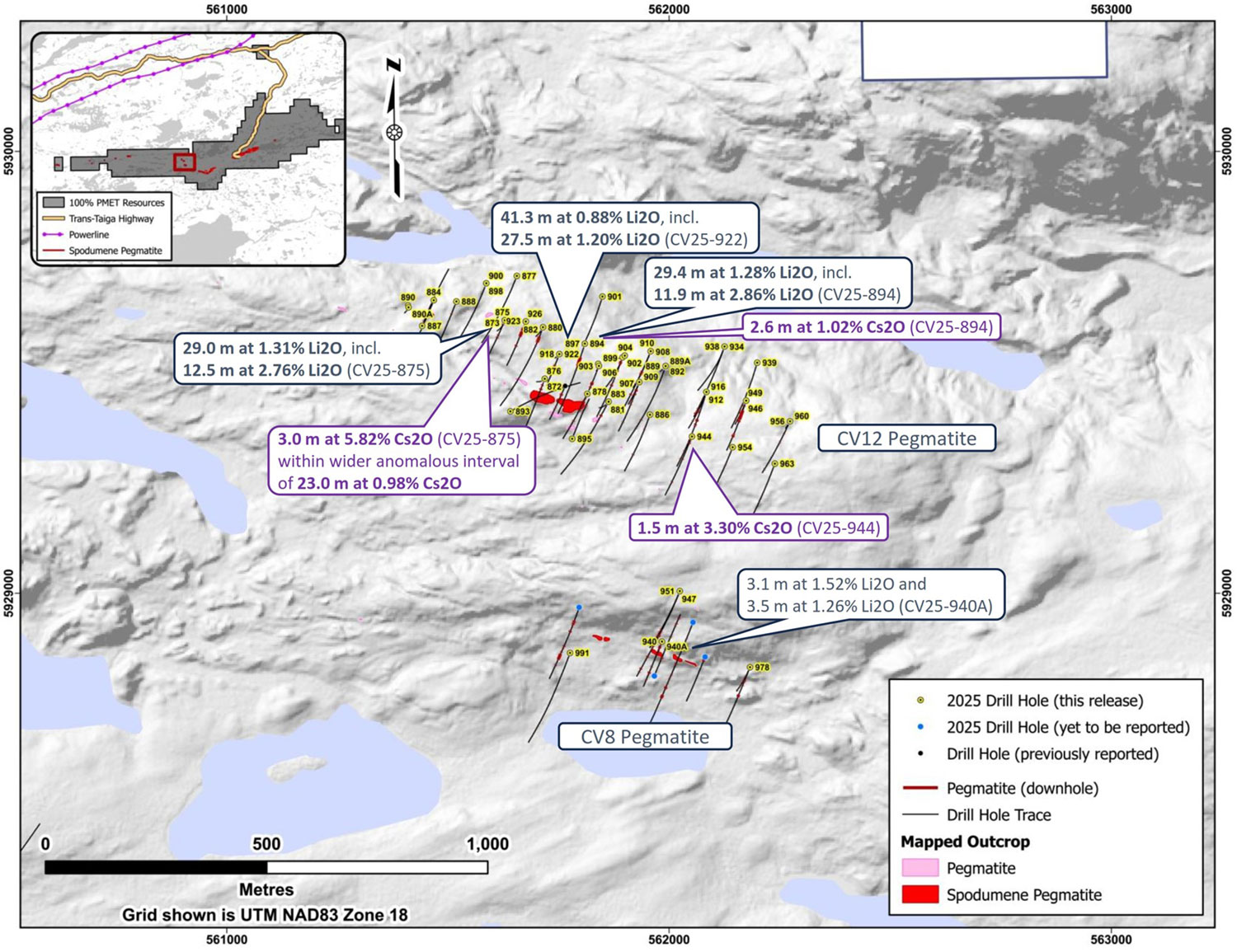
The CV12 Pegmatite, characterized at surface by multiple LCT pegmatite outcrops, is situated approximately 2.4 km along geological trend to the northwest of the CV13 Pegmatite. The 2025 campaign followed up on a single drill hole (2021) at the prospect, with a total 10,102 m (51 holes) completed and all results announced herein (see Figure 4, Table 2, and Table 7).
The drilling was successful, tracing the pegmatite over a strike length of approximately 850 m, with multiple wide and well-mineralized lithium intercepts. Of particular interest are the very high grades in excess of 2.5% Li2O over intervals greater than 10 m obtained in two (2) holes, and which are reminiscent of the high-grade Vega and Nova zones at the CV13 and CV5 pegmatites, respectively. Drill results include:
- 29.0 m at 1.31% Li2O, including 12.5 m at 2.76% Li2O (CV25-875).
- 29.4 m at 1.28% Li2O, including 11.9 m at 2.86% Li2O (CV25-894).
- 41.3 m at 0.88% Li2O, including 27.5 m at 1.20% Li2O (CV25-922).
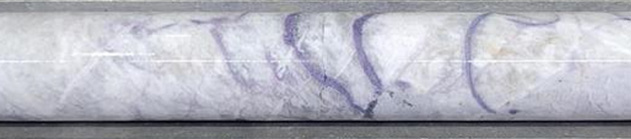
A preliminary review of the core indicates that the mineralization style in CV12 drill holes is similar to that of the pegmatites at CV13, CV5, and CV4, characterized by large spodumene crystals hosted within a quartz-feldspar pegmatite. The spodumene mineralization consists of off-white to pale-green crystals of centimetre to decimetre scale, which are relatively free of inclusions (Figure 5). This suggests potential amenability to dense media separation (“DMS”) process methods, which extensive testwork at CV5 has demonstrated to be very effective. Additionally, grades of tantalum in drill hole at CV12 are very strong (see Table 2).
Additionally, drilling has outlined a new caesium zone discovery at CV12 with intercepts including 3.0 m at 5.82% Cs2O within a wider anomalous zone of 23.0 m at 0.98% Cs2O (CV25-875). Other intercepts include 1.5 m at 3.30% Cs2O (CV25-944), 1.4 m at 1.77% Cs2O (CV25-923), 2.6 m at 1.02% Cs2O (CV25-894), and 4.4 m at 0.90% Cs2O (CV25-902). The caesium mineralization was intercepted at shallow depths (typically <15 to 50 m vertical depth from surface) and has been traced in multiple holes over an approximate 200 m strike length at ~1 to 4 m thickness. Pollucite, the ideal caesium host mineral – due to its high caesium content and ease of recovery – was also visually identified in several drill holes (Figure 6). More drilling is required to constrain the zone; however, its shallow depth, long strike length, and strong grades are very encouraging.
Figure 4: Drill holes completed through 2025 at the CV12 Pegmatite and CV8 Pegmatite.
Figure 5: Large spodumene crystals in drill hole CV25-875 at ~32 m depth (core length) at the CV12 Pegmatite. Core graded 2.9 m at 2.70% Li2O over sample interval (30.1 m to 33.0 m).
Figure 6: Large crystals of pollucite in drill hole CV25-880 at ~33 m depth (core length) at the CV12 Pegmatite. Core graded 1.5 m at 0.59% Cs2O over sample interval (33.0 m to 34.5 m).
CV13 Pegmatite
The 2025 drilling at the CV13 Pegmatite included infill and step-out holes, and geomechanical drilling in support of development. A total of 23,451 m (106 holes) were completed, of which, results for 9,771 m (59 holes) are announced herein (see Figure 7, Table 3, and Table 7). Assays remain pending for multiple infill and step-out holes at the CV13 Pegmatite, including the high-grade (Li, Cs, Ta) Vega Zone.
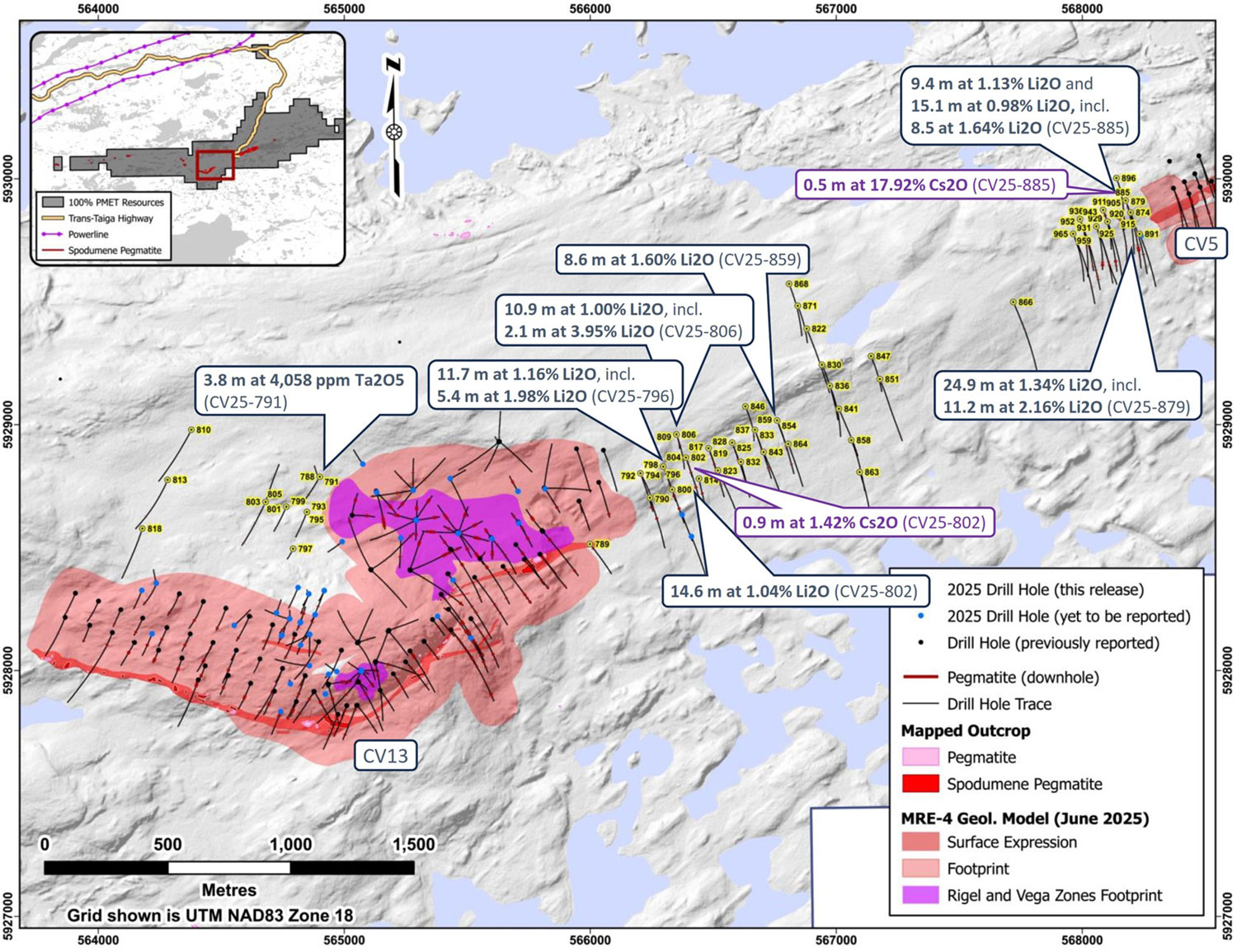
The drilling successfully extended the CV13 Pegmatite northeast approximately 0.7 km towards the CV5 Pegmatite with drill intercepts including 14.6 m at 1.04% Li2O (CV25-802), 11.7 m at 1.16% Li2O (CV25-796), and 10.9 m at 1.00% Li2O including a very high-grade zone 2.1 m at 3.95% Li2O (CV25-806). A caesium intercept of 0.9 m at 1.42% Cs2O (CV25-802) was also returned in this area, highlighting the potential for additional caesium enriched lenses to be delineated at CV13. The strike-length of the CV13 Pegmatite now extends approximately 3.2 km and remains open in several directions.
A roughly 100-150 m spaced drill hole fence was completed a further 250 m along strike to the northeast, testing the top 150-200 m from surface; however, did not intersect any material pegmatite intervals. This suggests the pegmatite body may narrow and/or deflect (potentially to depth below 150-200 m) at some point along the corridor.
Step-out drilling to the northwest of the Vega Zone successfully extended the pegmatite at least 200 m. The pegmatite intervals in these holes are weakly mineralized in lithium and caesium; however, carry high-grade tantalum including 3.8 m at 4,058 Ta2O5 ppm (CV25-791). A preliminary interpretation, supported by drill hole and geophysical data, suggests a potential fault in this area, which may have potentially offset the Vega Zone northerly where it remains to be drill tested. The Vega Zone remains open in several areas with results for multiple infill and step-out holes pending.
In addition to the exploration drilling, a geomechanical drill program at the CV13 Pegmatite was completed to support development and economic studies. In collaboration with independent engineering consultants, a total of 3,961 m (21 holes, HQ) were completed across the area targeting both pegmatite and host rock. Samples were collected for subsequent geomechanical lab testing and downhole optical/ acoustic televiewer surveys completed to support mine design and geological modelling. Assay results for pegmatite intervals in these holes remain to be reported.
Figure 7: Drill holes completed through 2025 at the CV13 Pegmatite and at the CV5 Pegmatite.
CV5 Pegmatite
The 2025 drilling at the CV5 Pegmatite and areas proximal in support of its development included step-out holes to the southwest as well as condemnation holes of proposed waste rock stockpiles and other key infrastructure locations. A total of 13,591 m (60 holes) were completed with all results announced herein (see Figure 7, Table 4, Table 5, and Table 7).
Drilling to test a southwestern extension of CV5 (7,101 m over 18 holes) was successful and traced the pegmatite approximately 0.4 km further along strike in this direction. Results include 24.9 m at 1.34% Li2O, including 11.2 m at 2.16% Li2O (CV25-879), 9.4 m at 1.13% Li2O (CV25-885), and 15.1 m at 0.98% Li2O (CV25-885). The strike-length of the CV5 Pegmatite now extends approximately 5.0 km and remains open in several directions.
Additionally, a high-grade caesium intercept of 1.0 m at 9.1% Cs2O was returned in drill hole CV25-855 over the extension. The interval included the highest-grade individual caesium sample collected to date at CV5 (0.5 m at 17.9% Cs2O) with massive pollucite visually identified (Figure 8). This discovery is open in several directions and highlights the potential for well-mineralized pods of caesium (via the mineral pollucite) at CV5 as a co-product to lithium and tantalum.
Figure 8: Massive pollucite with lepidolite veining in drill hole CV25-885 at ~240 m depth (core length) at the CV5 Pegmatite’s southwestern extension. Core graded 0.5 m at 17.9% Cs2O over sample interval (240.2 m to 240.7 m).
The 2025 drill campaign also included condemnation drilling of waste rock Stockpiles 001 and 002 (5,465 m over 36 holes) as well as at the underground ramp and ventilation shaft (1,025 m over 6 holes) locations proposed in the recently completed lithium-only Feasibility Study on the CV5 Pegmatite (see news release dated October 20, 2025) (Figure 2). This drilling achieved its objectives of characterizing the local geology as well as condemning key areas, and will inform the pending Environmental and Social Impact Assessment (“ESIA”), and planned bulk sample for the Project.
CV8 Pegmatite
The CV8 Pegmatite, characterized at surface by multiple LCT pegmatite outcrops, is situated approximately 0.5 km south of the CV12 Pegmatite on a sub-parallel trend. A total of 2,523 m (11 holes) were completed, of which, results for 1,312 m (6 holes) are announced herein (see Figure 4, Table 6, and Table 7).
The best results from the holes announced herein at the CV8 Pegmatite are 3.1 m at 1.52% Li2O and 3.5 m at 1.26% Li2O – both from drill hole CV25-940A. These intervals also returned high-grade tantalum at 321 ppm Ta2O5 and 295 ppm Ta2O5, respectively.
The target remains prospective and warrants further drilling given the association with ultramafic rocks proximal (often strongly associated with the widest spodumene pegmatite bodies at the Property), the large number of individual pegmatite intercepts in drill hole (suggests volume potential), and the presence of spodumene in the system (lithium budget is present).
Next Steps
The geology team is currently interpreting and working with the new drill hole data to advance the host rock and pegmatite geological models for the Project. The work is focused on the CV5 and CV13 pegmatites ahead of updates that will feed into updated block models, culminating into a revised economic study scheduled for the second half of 2026. The data will also inform an underground bulk sample of mineralized pegmatite at CV5, which is currently being permitted.
Results remain to be reported for 15,081 m (72 holes), of which the vast majority are from infill and step-holes at the CV13 Pegmatite, including the high-grade (Li-Cs-Ta) Vega Zone. Final assay certificates are anticipated to be received over the holidays and therefore results for the final drill holes of the 2025 campaign will be reported in the new year.
IBF4