Standard Uranium Announces Results of High-Resolution TDEM Survey at the Corvo Uranium Project, Northern Saskatchewan
Press Release
Vancouver, British Columbia, July 23, 2025 — Standard Uranium Ltd. (“Standard Uranium” or the “Company”) (TSX-V: STND) (OTCQB: STTDF) (Frankfurt: FWB:9SU0) is pleased to provide a summary of positive results from an airborne Time Domain Electromagnetic (“TDEM”) survey completed on its 12,265-hectare Corvo Uranium Project (“Corvo”, or the “Project”) earlier this year. The Project is currently under a three-year earn-in option agreement with Aventis Energy Inc. (“Aventis”) (CSE: AVE).
Highlights:
- Refined EM Conductors: The modern TDEM dataset confirms and improves previously defined EM conductors on the Project, outlining 29 kilometres of prospective exploration strike length across the Project. Multiple high-priority target areas along the conductors have been identified based on overlapping historical geochemical surveys, sampling, and existing drill hole uranium intercepts.
- Integrated Target Development: The results of the recent airborne TDEM survey are currently undergoing further digital processing and modeling to prioritize target areas for inaugural drilling in 2026.
- Maiden Drill Program: A diamond drill program is being planned for Q1 2026 to begin testing targets developed and ranked through the detailed exploration and geophysical programs executed in 2025.
“Upgrading and confirming the presence of conductive corridors across the Project is an ideal first step in our exploration efforts at Corvo. Along with the recently completed prospecting and sampling program this month, we’ve confirmed the presence of at least 29 kilometres of conductive stratigraphy as well as multiple radioactive occurrences at surface,” commented Sean Hillacre, President & VP Exploration of Standard Uranium. “We look forward to receiving our prospecting assay results as we complete the first NI 43-101 report on the Project and plan our next phase of geophysical surveys building towards targets for the 2026 drill program.”
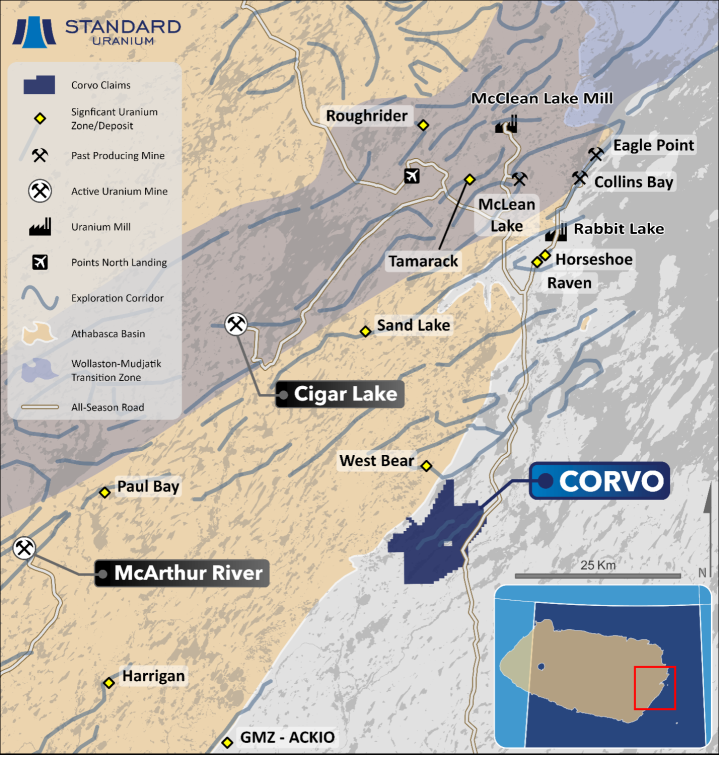
Figure 1. Regional map of the Corvo Project. The Project is located 45 km northeast of Atha Energy’s Gemini Mineralized Zone (“GMZ”) and 60 km due east of Cameco’s McArthur River mine.
Corvo – 2025 Exploration Summary
From February 22 to March 16, 2025, the Company contracted Axiom Exploration Group Ltd. in partnership with New Resolution Geophysics to carry out a helicopter-borne Xcite™ TDEM and total field magnetic survey over the 12,265-hectare Corvo Project. The survey covered all 13 mineral claims of the Project, totalling 1,670.5 line-kms with a traverse line spacing of 100 m and tie-line spacing of 1,000 m over a ~122.65 km2 area.
The helicopter-assisted survey was flown using the 30Hz Xcite™ TDEM system that simultaneously collects time domain electromagnetic, and magnetic data. The extensive survey was aimed to detect, locate, and characterize anomalous conductive and magnetic responses across the Corvo Property to aid in future exploration drill hole targeting.
The survey was completed on schedule, on budget, and successfully gathered high-resolution data to depth that will be key to identifying exploration targets under glacial cover through the delineation of conductive trends possibly related to packages of graphite and/or sulphide-bearing metasedimentary rocks commonly associated with uranium mineralization. Subsequent inversion, interpretation, and modeling of the recently acquired data in 3D software will allow the Company to prioritize newly identified exploration targets for follow-up diamond drilling programs.
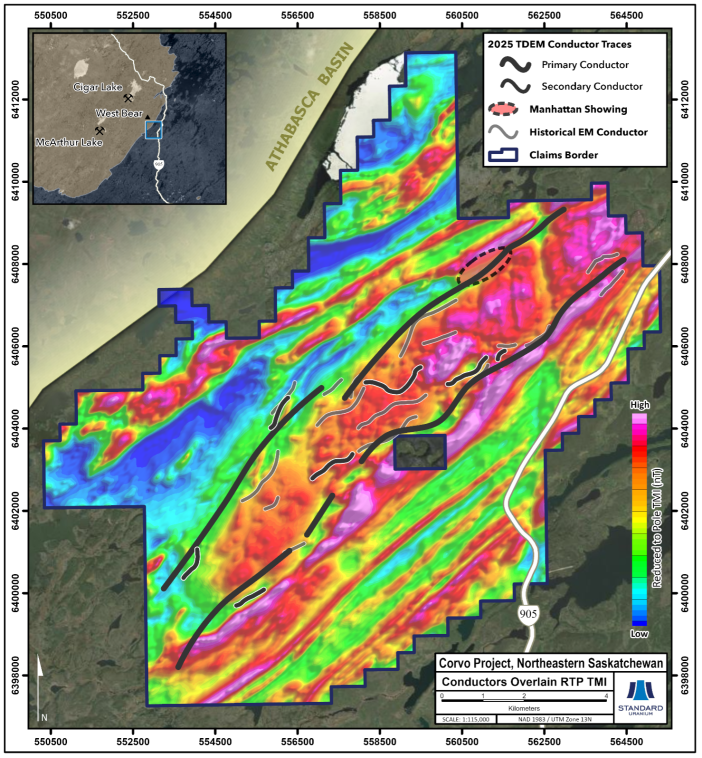
The survey results confirm and improve upon the previously defined conductive corridors on the Project that overlap with historical geophysical and geochemical anomalies, in addition to drill holes with known uranium intercepts. The magnetic survey component of the TDEM survey contributes to definition of potential fault systems and structural trends not previously identified across the Project.
Supplementary geophysical surveys are being designed to further refine drill targets for an inaugural drill program. The Company plans to complete a high-resolution ground gravity survey across the main conductive trends on the Project, aiming to identify potential hydrothermal alteration halos which could be related to basement-hosted uranium mineralization.
From July 4 to July 16, 2025, the Company’s technical team completed a detailed mapping, prospecting, and sampling program to ground-truth historical uranium showings at surface. Collected grab samples have been transported to Saskatchewan Research Council Geoanalytical Laboratories in Saskatoon, SK for geochemical analysis. Results will be released and incorporated into the first NI 43-101 technical report on the Project.
The Company believes the Project is highly prospective for the discovery of shallow, high-grade basement-hosted uranium mineralization akin to the Rabbit Lake deposit and the recently discovered Gemini Mineralized Zone. Located just outside the current margin of the Athabasca Basin, Corvo boasts shallow drill targets with bedrock under minimal cover of glacial till. Several outcrop showings of mineralized veins and fractures are present on the Project, notably the Manhattan Showing that returned historical sample results up to 59,800 ppm U at surface1 and has never been drill tested.
Figure 2. Summary map showing modern TDEM conductor traces on the Corvo project with Reduced to Pole (RTP) Total Magnetic Intensity (TMI) in the background.
*The Company considers uranium mineralization with concentrations greater than 1.0 wt% U3O8 to be “high-grade”.
**The Company considers radioactivity readings greater than 300 counts per second (cps) to be “anomalous”.
Qualified Person Statement
The scientific and technical information contained in this news release has been reviewed, verified, and approved by Sean Hillacre, P.Geo., President and VP Exploration of the Company and a “qualified person” as defined in NI 43-101.
Historical data disclosed in this news release relating to sampling results from previous operators are historical in nature. Neither the Company nor a qualified person has yet verified this data and therefore investors should not place undue reliance on such data. The Company’s future exploration work may include verification of the data. The Company considers historical results to be relevant as an exploration guide and to assess the mineralization as well as economic potential of exploration projects. Any historical grab samples disclosed are selected samples and may not represent true underlying mineralization.
References
1 SMDI# 2052: https://mineraldeposits.saskatchewan.ca/Home/Viewdetails/2052 & Mineral Assessment Report MAW00047: Eagle Plains Resources Inc., 2011-2012
About Standard Uranium (TSX-V: STND)
We find the fuel to power a clean energy future
Standard Uranium is a uranium exploration company and emerging project generator poised for discovery in the world’s richest uranium district. The Company holds interest in over 233,455 acres (94,476 hectares) in the world-class Athabasca Basin in Saskatchewan, Canada. Since its establishment, Standard Uranium has focused on the identification, acquisition, and exploration of Athabasca-style uranium targets with a view to discovery and future development.
Standard Uranium’s Davidson River Project, in the southwest part of the Athabasca Basin, Saskatchewan, comprises ten mineral claims over 30,737 hectares. Davidson River is highly prospective for basement-hosted uranium deposits due to its location along trend from recent high-grade uranium discoveries. However, owing to the large project size with multiple targets, it remains broadly under-tested by drilling. Recent intersections of wide, structurally deformed and strongly altered shear zones provide significant confidence in the exploration model and future success is expected.
Standard Uranium’s eastern Athabasca projects comprise over 42,384 hectares of prospective land holdings. The eastern basin projects are highly prospective for unconformity related and/or basement hosted uranium deposits based on historical uranium occurrences, recently identified geophysical anomalies, and location along trend from several high-grade uranium discoveries.
Standard Uranium’s Sun Dog project, in the northwest part of the Athabasca Basin, Saskatchewan, is comprised of nine mineral claims over 19,603 hectares. The Sun Dog project is highly prospective for basement and unconformity hosted uranium deposits yet remains largely untested by sufficient drilling despite its location proximal to uranium discoveries in the area
For further information contact:
Jon Bey, Chief Executive Officer, and Chairman
Suite 3123, 595 Burrard Street
Vancouver, British Columbia, V7X 1J1
Tel: 1 (306) 850-6699
E-mail: info@standarduranium.ca
IBF4