





Standard Uranium Provides Drilling Update on the 2026 Drill Program at Flagship Davidson River Project – Announces Elevated Radioactivity in First Drill Hole
Press Release
Vancouver, British Columbia, June 15, 2026 — Standard Uranium Ltd. (“Standard Uranium” or the “Company”) (TSX-V: STND) (OTCQB: STTDF) (Frankfurt: FWB:9SU) is pleased to provide an update on drilling activities at its flagship Davidson River Project (“Davidson River” or the “Project”), located in the southwest Athabasca Basin, Saskatchewan, Canada. Drilling began on June 1, 2026, and a total of 900 metres have been completed to date in two in-progress holes on the Bronco and Thunderbird corridors. The first drill hole of the program, DR-26-040, on the Bronco corridor has intersected a total of three metres of anomalous* radioactivity (>300 counts per second) with peaks up to 540, 780, and 1,650 counts per second (“cps”) from 464.0 to 466.0 metres.
Both ongoing drill holes have intersected strongly graphitic basement structures associated with increased hydrothermal alteration including hematite and clay. Intervals of anomalous radioactivity intersected in hole DR-26-040 are associated with brittle reactivated structures along the Bronco corridor.
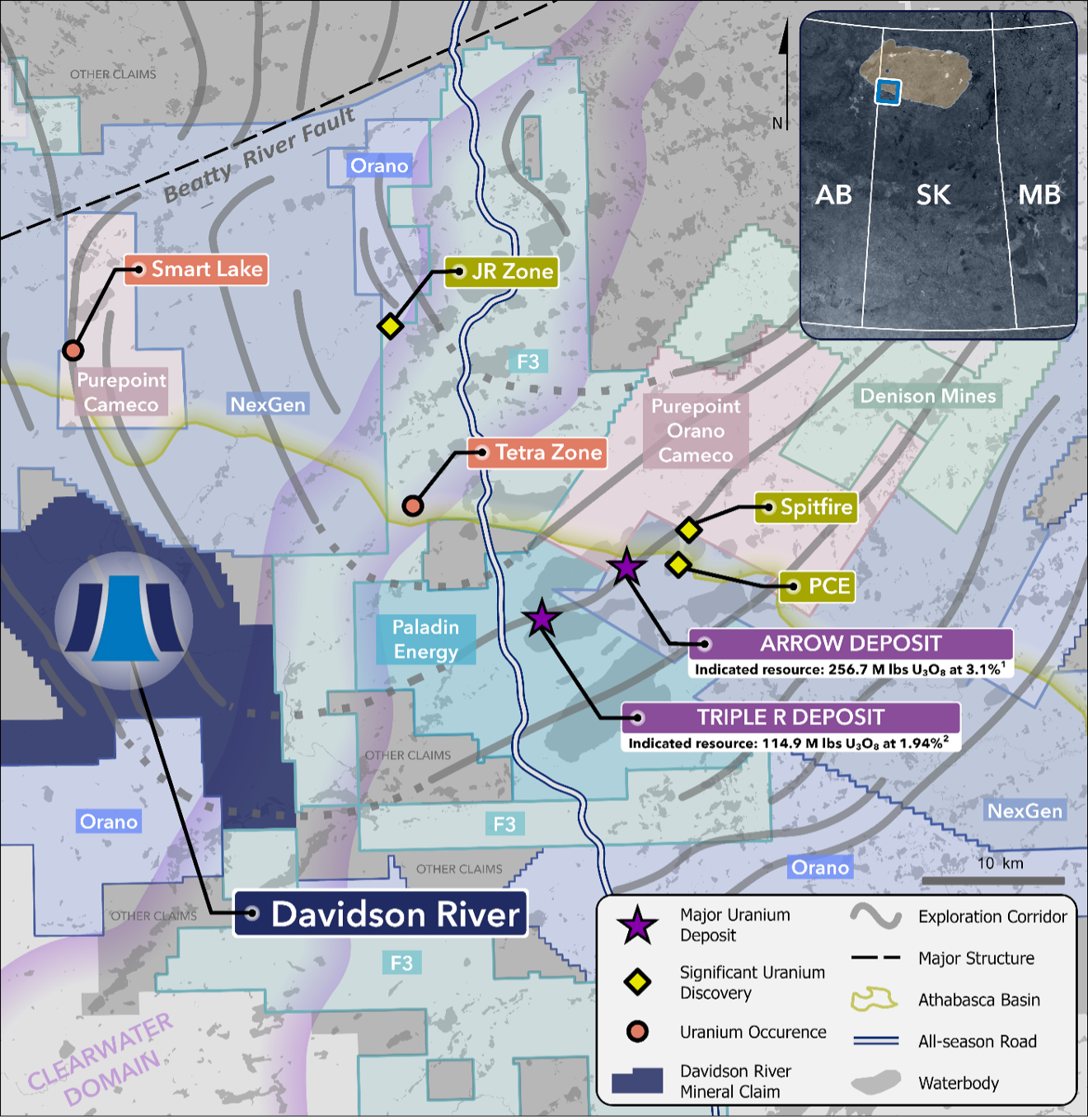
Drilling is ongoing and is planned to continue through August 2026. The summer drill campaign is targeting basement-hosted, high-grade** uranium mineralization on the same regional structural trends that host significant uranium deposits including NexGen Energy’s Arrow deposit and Paladin Energy’s Triple R deposit (Figure 1).
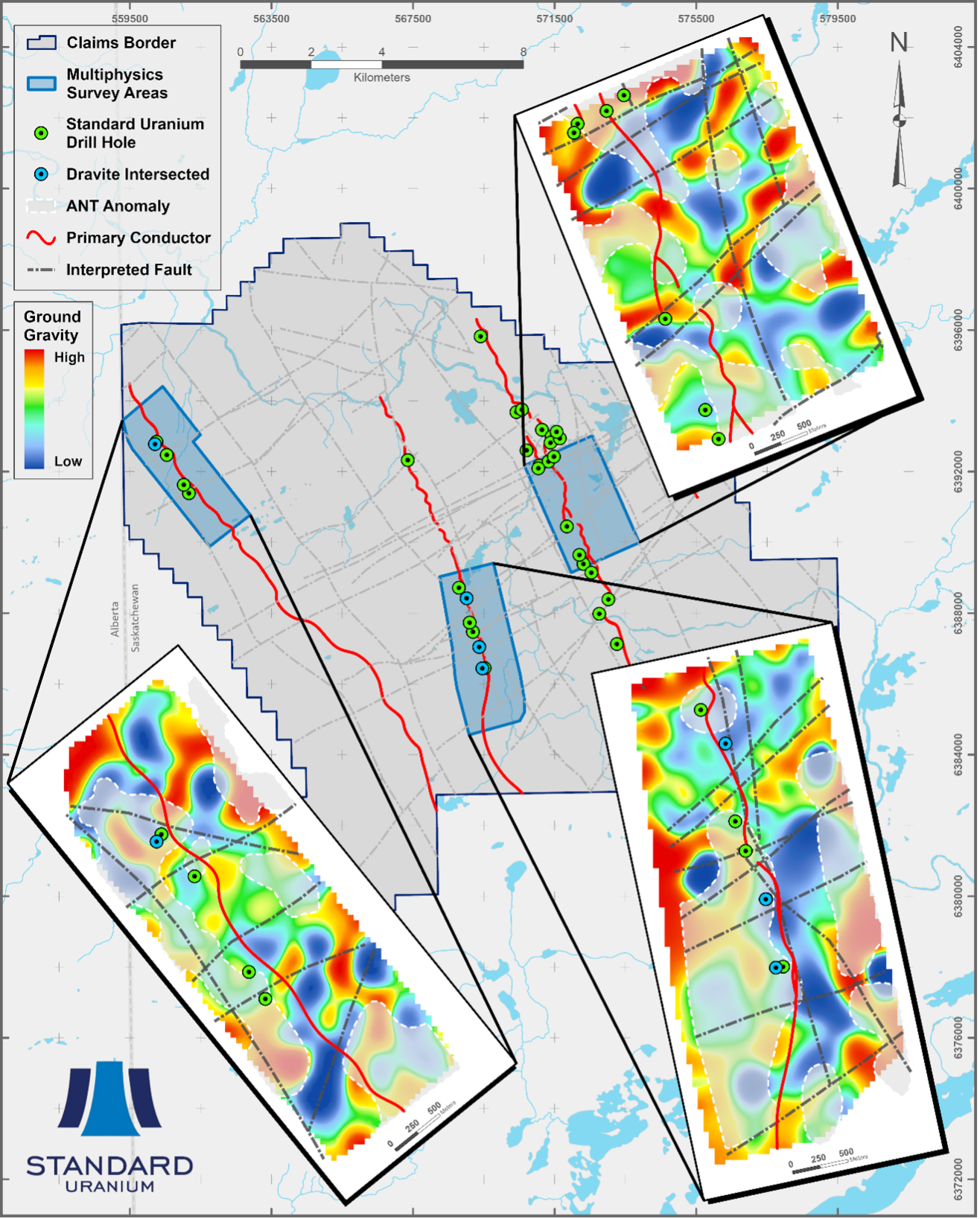
“Hitting elevated radioactivity and massive basement structures on the first hole of the drill program is exciting, but more than that, it increases our confidence in our new targeting dataset,” said Sean Hillacre, P.Geo., President & VP Exploration of Standard Uranium. “The integration of ExoSphere multiphysics data with our existing drill results, ground gravity, EM conductors, and machine-learning targeting has materially upgraded our understanding of the subsurface at Davidson River. Distinct gravity-low anomalies, coincident with known conductors and basement structure, give us drill targets along Warrior, Bronco, and Thunderbird that we are very excited to test. Our methodology mirrors the targeting approach that has led to world-class discoveries elsewhere in this district, and we are bringing that toolkit to a 30,737-hectare position that has never been tested with this level of integrated science.”
Program Highlights
- Drill targets prioritized and locked-in across three of the four major conductor corridors at Davidson River – Warrior, Bronco, and Thunderbird – based on the integration of the first-ever ExoSphere Multiphysics surveys completed in the southwest Athabasca Basin region (Figure 2).
- Drills hitting intended meterage with two drill rigs deployed 24/7 to maximize metres drilled and accelerate the testing of the Company’s highest-confidence targets ever generated on the property.
Figure 1. Overview of Standard Uranium’s Flagship Davidson River Project in the southwest Athabasca Basin uranium district along trend from significant uranium discoveries and resources1,2.
Figure 2. Summary of results from Multiphysics surveys on the Warrior, Bronco, and Thunderbird corridors, highlighting integrated target areas – EM conductors, cross-faults, density lows, and velocity lows.
Table 1. Davidson River drill hole information as of June 15, 2026 – Drilling ongoing
| DDH | Orientation
Azi/Dip (°) |
Target Area | Handheld Spectrometer Results (RS-125) | ||||
| From (m) | To (m) | Width (m) | Min cps | Max cps | |||
| DR-26-040 | 080/-65 | Bronco | 279.5 | 280.0 | 0.5 | <300 | 300 |
| 397.0 | 397.5 | 0.5 | <300 | 300 | |||
| 398.0 | 398.5 | 0.5 | <300 | 300 | |||
| 464.0 | 464.5 | 0.5 | <300 | 1,650 | |||
| 464.5 | 465.0 | 0.5 | <300 | 540 | |||
| 465.5 | 466.0 | 0.5 | <300 | 780 | |||
| DR-26-041 | 050/-70 | Thunderbird | No elevated radioactivity; Drill hole ongoing | ||||
Scroll to the right to see the table data.
About the Davidson River Project
Davidson River includes 10 contiguous mineral dispositions totaling 30,737 hectares and lies approximately 25 km west of the Arrow and Triple R uranium deposits and 75 km south of the past-producing Cluff Lake uranium mine. The Company has completed 16,561 metres of diamond drilling in 39 drill holes on the Davidson River property since 2020, which has further refined the exploration strategy for high-grade basement hosted uranium mineralization on the property. The flagship property hosts more than 70 km of conductive trends across four main structural corridors – the Warrior, Bronco, Thunderbird, and Saint trends. All four geophysical corridors contain multiple target areas favorable for high-grade basement hosted uranium mineralization.
Qualified Person Statement
The scientific and technical information contained in this news release has been reviewed and approved by Sean Hillacre, P.Geo., President and VP Exploration of the Company and a “qualified person” as defined in NI 43-101 – Standards of Disclosure for Mineral Projects.
Geochemical assays are pending. Samples collected for analysis were sent to SRC Geoanalytical Laboratories in Saskatoon, Saskatchewan for preparation, processing, and ICP-MS or ICP-OES multi-element analysis using total and partial digestion and boron by fusion. SRC is an ISO/IEC 17025:2005 and Standards Council of Canada certified analytical laboratory. Blanks, standard reference materials, and repeats were inserted into the sample stream at regular intervals in accordance with Standard Uranium’s quality assurance/quality control (“QA/QC”) protocols. All sample results will be subject to internal QA/QC protocols prior to subsequent release.
Natural gamma radiation from rocks reported in this news release was measured in counts per second (“cps”) using a handheld RS-125 super-spectrometer and RS-120 super-scintillometer. Readers are cautioned that scintillometer readings are not uniformly or directly related to uranium grades of the rock sample measured and should be treated only as a preliminary indication of the presence of radioactive minerals. Because the orientation of mineralization is unknown, true widths are unknown and reported intervals represent core lengths. The RS-125 and RS-120 units supplied by Radiation Solutions Inc. (“RSI”) have been calibrated on specially designed Test Pads by RSI. Standard Uranium maintains an internal QA/QC procedure for calibration and calculation of drift in radioactivity readings through three test pads containing known concentrations of radioactive minerals. Internal test pad radioactivity readings are known and regularly compared to readings measured by the handheld scintillometers for QA/QC purposes.
Historical data disclosed in this news release relating to sampling results from previous operators are historical in nature. Neither the Company nor a qualified person has yet verified this data and therefore investors should not place undue reliance on such data. The Company’s future exploration work may include verification of the data. The Company considers historical results to be relevant as an exploration guide and to assess the mineralization as well as economic potential of exploration projects. Any historical grab samples disclosed are selected samples and may not represent true underlying mineralization.
References
1 Arrow deposit, Rook I Project, Saskatchewan, NI 43-101 Technical Report on Feasibility Study, Prepared for NexGen Energy Ltd., Effective date: February 22, 2021
2 Feasibility Study, NI 43-101 Technical Report, for PLS Property, Prepared for Fission Uranium Corp., Effective date: January 17, 2023
* Using a handheld RS-125 Super-Spectrometer, readings exceeding 300 counts per second (cps) are considered “anomalous,” while those exceeding 65,535 cps are considered “off-scale.”
** The Company defines uranium concentrations greater than 1.0 wt.% as “high-grade.”
*** Natural gamma radiation reported in this news release was measured in counts per second (cps) using a handheld RS-125 super-spectrometer. Readers are cautioned that handheld scintillometer/spectrometer and/or gamma probe readings are not uniformly or directly related to uranium grades of the rock sample measured and should be treated only as a preliminary indication of the presence of radioactive minerals.
**** The Company cautions that results or discoveries on properties in proximity to the Company’s properties may not necessarily be indicative of the presence of mineralization on the Company’s properties.
About Standard Uranium (TSX-V: STND)
We find the fuel to power a clean energy future
Standard Uranium is a uranium exploration company and emerging project generator poised for discovery in one of the world’s premier uranium districts. The Company holds interest in over 223,900 acres (90,609 hectares) in the Athabasca Basin in Saskatchewan, Canada. Since its establishment, Standard Uranium has focused on the identification, acquisition, and exploration of Athabasca-style uranium targets with a view to discovery and future development.
Standard Uranium’s Davidson River Project, in the southwest part of the Athabasca Basin, Saskatchewan, comprises ten mineral claims over 30,737 hectares. Davidson River is highly prospective for basement-hosted uranium deposits due to its location along trend from recent high-grade uranium discoveries. However, owing to the large project size with multiple targets, it remains broadly under-tested by drilling. Recent intersections of wide, structurally deformed and strongly altered shear zones provide significant confidence in the exploration model and future success is expected.
Standard Uranium’s eastern Athabasca projects comprise over 40,268 hectares of prospective land holdings. The eastern basin projects are highly prospective for unconformity related and/or basement hosted uranium deposits based on historical uranium occurrences, recently identified geophysical anomalies, and location along trend from several high-grade uranium discoveries.
Standard Uranium’s Sun Dog project, in the northwest part of the Athabasca Basin, Saskatchewan, is comprised of nine mineral claims over 19,603 hectares. The Sun Dog project is highly prospective for basement and unconformity hosted uranium deposits yet remains largely untested by sufficient drilling despite its location proximal to uranium discoveries in the area.
For further information contact:
Jon Bey, Chief Executive Officer, and Chairman
Suite 3123, 595 Burrard Street
Vancouver, British Columbia, V7X 1J1
Tel: 1 (306) 850-6699
E-mail: info@standarduranium.ca
IBF4