





Widest and Highest-Grade Caesium Intercepts to Date at Vega including 28.0 m at 8.05% Cs2O and 2.2 m at 26.48% Cs2O
Press Release
February 3, 2026
Highlights
- Widest and highest-grade caesium intercepts reported to date at theVega Zone:
- 28.0 m at 8.05% Cs2O including 18.3 m at 11.84% Cs2O (CV25-948).
- 18.2 m at 7.13% Cs2O including 3.0 m at 23.63% Cs2O (CV25-1023).
- 5.5 m at 14.83% Cs2O including 2.2 m at 26.48% Cs2O (CV25-1006)
- Includes highest-grade sample reported to date at 29.79% Cs2O
- 11.5 m at 1.75% Cs2O including 2.9 m at 3.88% Cs2O (CV25-1025).
- 16.1 m at 1.43% Cs2O including 1.3 m at 11.08% Cs2O (CV25-1010).
- Interpreted footprint and width of caesium mineralization at Vega expanded.
- High-grade caesium intercept from in-fill drilling at the Rigel Zone:
- 6.2 m at 5.12% Cs2O including 2.1 m at 13.68% Cs2O (CV25-914).
- High-grade caesium confirmed at the newly-discovered Helios Zone:
- 1.0 m at 21.52% Cs2O (CV25-975).
- Caesium assay results reported in this announcement for 8,596 m (52 holes) drilled at the CV13 Pegmatite – including the Vega, Rigel, and Helios Zones.
- Caesium assay results for 1,176 m (7 holes) from the Vega and Helios Zones remain pending.
Darren L. Smith, Executive Vice President Exploration, comments: “Shaakichiuwaanaan continues to deliver impressive results, with the 2025 drill campaign returning the highest caesium grades reported to date at the Property – including a peak assay of 29.8% Cs2O – and confirming high-grade caesium at the newly discovered Helios Zone. With multiple intercepts exceeding 25% Cs2O, dominant pollucite mineralogy, and scale already demonstrated through defined Mineral Resources, the opportunity for the Company to further enhance shareholder value through this caesium deposit is meaningful.”
“We look forward to reporting caesium results for the remaining holes outstanding and integrating this opportunity into the overall Project development scenario,” added Mr. Smith.
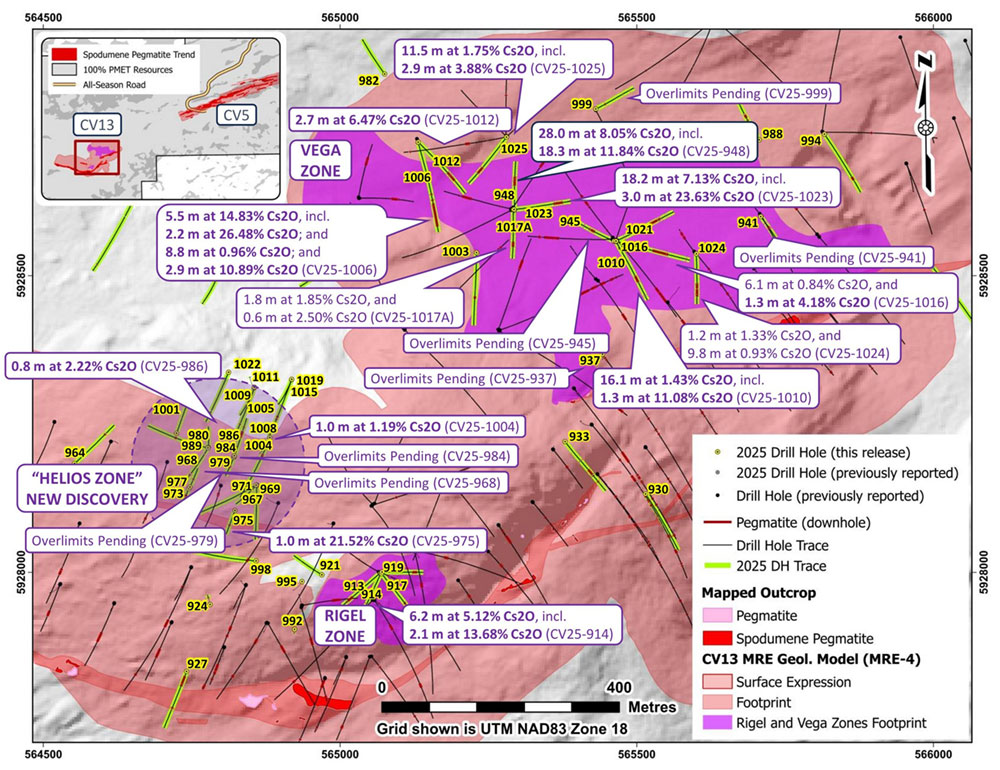
Figure 1: Drill hole result highlights at the CV13 Pegmatite (caesium).
PMET Resources Inc. (the “Company” or “PMET”) (TSX: PMET) (ASX: PMT) (OTCQX: PMETF) (FSE: R9GA) is pleased to report caesium assay results for diamond drill holes completed at the CV13 Pegmatite, as part of its extensive 2025 drill campaign at the Company’s wholly-owned Shaakichiuwaanaan Property (the “Property” or “Project”), located in the Eeyou Istchee James Bay region of Quebec.
In addition to being one of the largest lithium-tantalum pegmatite Mineral Resources[1] and lithium pegmatite Mineral Reserves[2] globally, the Property also hosts the world’s largest in-situ pollucite-hosted caesium pegmatite Mineral Resource, with 0.69 Mt at 4.40% Cs2O (Indicated) and 1.70 Mt at 2.40% Cs2O (Inferred). The CV13 Pegmatite, host to the caesium Mineral Resource, is located ~3 km along trend from the CV5 Pegmatite, which is situated approximately 13 km south of the regional Trans-Taiga Road and powerline infrastructure corridor, and is accessible year-round by road.
As part of its expansive 2025 drill campaign at Shaakichiuwaanaan, the Company completed further delineation drilling at the Vega and Rigel caesium zones. This exploration campaign also resulted in the discovery of the Helios Caesium Zone. All three caesium zones – Vega, Rigel, and Helios – are situated within the CV13 Pegmatite and are largely coincident with lithium and tantalum mineralization.
Core assay results for caesium for 8,596 m (52 holes) at the CV13 Pegmatite are reported in this announcement, including prior pending overlimit[3] analysis (see Figure 1, Table 1, Table 2, Table 3). Core assay results for caesium for 1,176 m (7 holes), covering the Vega and Helios zones, remain to be reported. Results for lithium and tantalum for all drill holes completed in 2025 at Shaakichiuwaanaan were previously reported (see news releases dated December 14, 2025 and January 21, 2026). All reported widths are core length (i.e., apparent and not true width).
Vega Caesium Zone
The strongest caesium results to date from the Property were returned from the 2025 drill campaign at the Vega Zone, including ten (10) individual samples grading >20% Cs2O and four (4) grading >25% Cs2O to a peak of 29.79%, as well as multi-metre intercepts including 3.0 m at 23.63% Cs2O, 3.0 m at 23.05 Cs2O, and2.2 m at 26.48% Cs2O (see Table 1, Figure 3, and Figure 4). Most of the holes were completed as infill, targeting a central high-grade core that had been interpreted from previous drilling. However, several holes were also completed at the margins of the modelled zone (e.g., CV25-1006). Based on the assay results reported in this announcement, the interpreted footprint and width of the caesium mineralization at Vega have increased. At Vega, drill result highlights for caesium include:
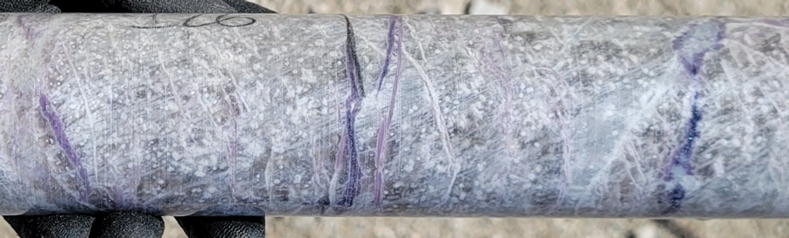
- 28.0 m at 8.05% Cs2O including 18.3 m at 11.84% Cs2O (CV25-948), see Figure 2.
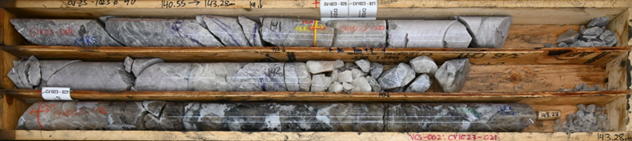
- 18.2 m at 7.13% Cs2O including 3.0 m at 23.63% Cs2O (CV25-1023), see Figure 3.
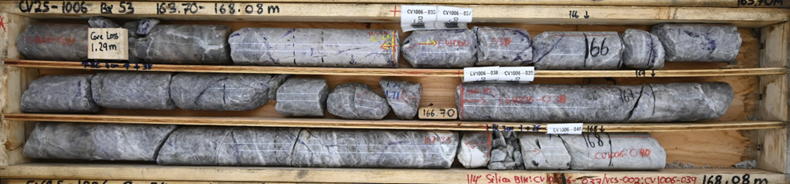
- 5.5 m at 14.83% Cs2O including 2.2 m at 26.48% Cs2O (CV25-1006), see Figure 4.
- Includes highest-grade sample reported to date at the Project – 29.79% Cs2O
- 11.5 m at 1.75% Cs2O including 2.9 m at 3.88% Cs2O (CV25-1025).
- 16.1 m at 1.43% Cs2O including 1.3 m at 11.08% Cs2O (CV25-1010).
- 8.8 m at 0.96% Cs2O and 2.9 m at 10.89% Cs2O (CV25-1006).
- 9.8 m at 0.93% Cs2O and 1.2 m at 1.33% Cs2O (CV25-1024).
- 2.7 m at 6.47% Cs2O (CV25-1012)
Caesium results remain to be reported from Vega for multiple holes with overlimit[4] analysis pending over intervals of 0.5 to 2.3 m.
Figure 2: Pollucite with late stage lepidolite (purple) and spodumene/pollucite (white) veining displaying classic “tapioca” texture (white blebs) at a depth of ~126 m in drill hole CV25-948 from the Vega Zone. Core grades 1.9 m at 17.81% Cs2O (125.0 m to 126.9 m) within a wider mineralized interval of 28.0 m at 8.05% Cs2O (116.5 m to 144.5 m)
Figure 3: Large pollucite crystals in drill hole CV25-1023 from the Vega Zone. Core grades 3.0 m at 23.63% Cs2O (from 138.1 m to 141.1 m) within a wider mineralized interval of 18.2 m at 7.13% Cs2O (138.1 m to 156.2 m)
Figure 4: Massive pollucite mineralization in drill hole CV25-1006 from the Vega Zone. Core grades 2.2 m at 26.48% Cs2O (165.7 m to 167.8 m), including 1.0 m at 29.79% Cs2O, within a wider mineralized interval of 5.5 m at 14.83% Cs2O (162.3 m to 167.8 m)
Helios Caesium Zone (A NEW 2025 DISCOVERY)
High-grade caesium mineralization has been confirmed at the Helios discovery (Table 1, Figure 5). Mineralization has been traced over an area of ~180 m x 80 m at ~1 to 3 m thickness and comes within at least 25 m from surface (vertical depth). Mineralization remains open in several areas. At Helios, drill result highlights to date for caesium include:
- 1.0 m at 21.52% Cs2O (CV25-975), see Figure 5.
- 0.8 m at 2.22% Cs2O (CV25-986).
- 1.0 m at 1.19% Cs2O (CV25-1004).
Caesium results remain to be reported from Helios for multiple holes with overlimit[5] analysis pendingover intervals of 0.5 m to 4.9 m.
Figure 5: Massive pollucite mineralization in drill hole CV25-975 from the Helio Zone. Core grades 1.0 m at 21.52% Cs2O (36.5 m to 37.5 m).
Rigel Caesium Zone
Several holes were completed as infill at the Rigel Zone with results presented in Error! Reference source not found.. The best caesium result from the program was 6.2 m at 5.12% Cs2O including 2.1 m at 13.68% Cs2O in drill hole CV25-914. The assay results from the 2025 drill holes have altered the interpreted eastern footprint of the Rigel Zone, which will be updated as part of the next Mineral Resource Estimate iteration. Some of the highest caesium grades to date have been reported from the Rigel Zone, including 1.1 m at 26.61% Cs2O within a wider zone of 3.2 m at 10.24% Cs2O (CV23-204).
Next Steps
Caesium assays results for 1,176 m (7 holes) remain to be reported out of the total 57,024 m (245 holes) completed over the 2025 drill campaign at Shaakichiuwaanaan. These remaining results will be reported once received and compiled. The lithium and tantalum assay results have previously been reported for all 245 holes (see news releases dated December 14, 2025 and January 21, 2026).
The geology team is currently interpreting and working with the 2025 drill hole data to advance the host rock and pegmatite geological models for the Project. The work is focused on the CV5 and CV13 pegmatites – including the Vega, Rigel, and Helios caesium zones – ahead of updates to their respective block models and subsequent Mineral Resource Estimate. The Company is also advancing towards an updated Feasibility Study for the CV5 Pegmatite scheduled for the second half of 2026. The data will also inform an underground bulk sample of mineralized pegmatite at CV5, which is currently being permitted.
IBF4